

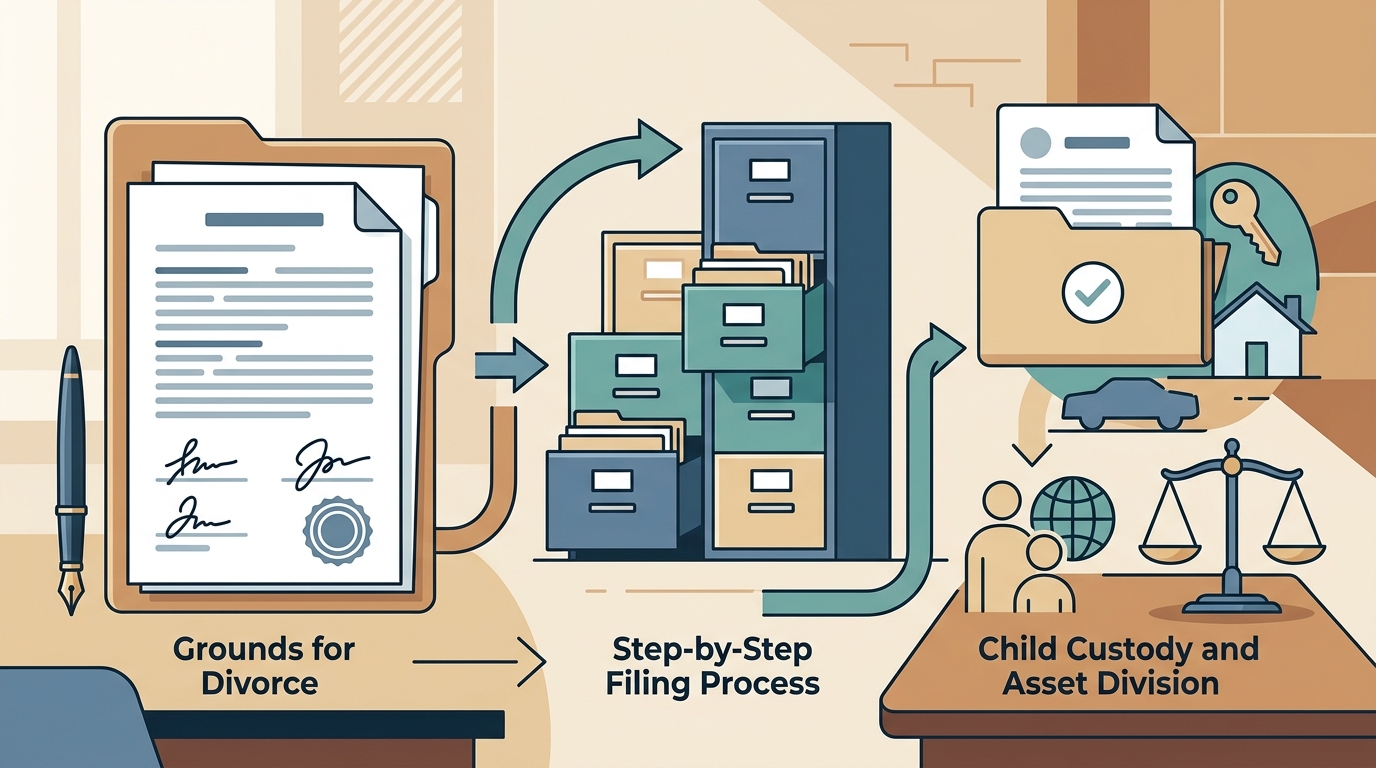
Filing for an uncontested divorce in Singapore requires both spouses to agree on the grounds for divorce and all ancillary matters, including child custody and asset division. This process is faster and less costly than contested proceedings. This guide covers the legal requirements, the step-by-step filing process, and how to manage ancillary matters effectively.
Eligibility and Requirements for Divorce
Before initiating any divorce proceedings, you must meet specific statutory criteria under the Women's Charter. Irretrievable breakdown is the sole ground for divorce in Singapore. You must demonstrate that the marriage has broken down beyond repair. The court accepts evidence of adultery, unreasonable behavior, desertion for at least one year, or separation for at least three years.
There are two primary eligibility hurdles. First, you must have a strong connection to Singapore. This means at least one spouse must be a Singapore citizen, a permanent resident, or have been ordinarily resident in Singapore for at least three years immediately preceding the filing. Second, the marriage must have lasted at least three years. If the marriage is shorter than three years, you can only file if you can prove exceptional hardship or exceptional cruelty.
It is important to note that you do not need to be physically separated for the entire three-year period if you are relying on other grounds like adultery or unreasonable behavior. However, separation is the most common and least contentious basis for an uncontested divorce. If you are unsure about your eligibility, consulting with a legal professional is the safest first step.
Agreeing on Ancillary Matters
An uncontested divorce is defined by the mutual agreement of both parties on all issues surrounding the marriage. Ancillary matters are the legal issues that must be resolved after the divorce is granted. These include the division of matrimonial assets, maintenance for the spouse, and the care and control of children.
Division of Matrimonial Assets
Matrimonial assets include property, savings, investments, and other assets acquired during the marriage. In an uncontested case, you and your spouse must agree on how to split these assets. This agreement should be documented in a consent order. It is crucial to disclose all assets fully to avoid future disputes or allegations of fraud.
Spousal Maintenance
Maintenance is financial support paid by one spouse to the other. In Singapore, the court considers the needs of the dependent spouse and the ability of the other to pay. If you agree on a maintenance amount, it must be reasonable and sustainable. You can agree to a lump sum or periodic payments. If you cannot agree, the court will decide based on its discretion.
Child Custody and Care
If you have children, you must agree on who will have care and control. Care and control determines where the child lives and who makes day-to-day decisions. You must also agree on visitation rights for the non-resident parent. The best interests of the child are the paramount consideration. If you cannot agree on custody, the case may become contested, even if other matters are settled.
The Step-by-Step Filing Process
Once you have agreed on all ancillary matters, you can proceed to file for divorce. The process involves several distinct stages. You will need to prepare specific legal documents and submit them to the Family Justice Courts.
Step 1: Prepare the Originating Process
The divorce is initiated by filing an Originating Process. This includes a Statement of Claim and a Statement of Defence. In an uncontested case, the Statement of Defence will admit the facts and confirm the agreement on ancillary matters. You must also file a Statement of Particulars of Matrimonial Assets, which lists all assets and liabilities.
Step 2: Serve the Documents
After filing, the court will issue a Summons. You must serve the Originating Process and Summons on your spouse. In an uncontested case, your spouse will acknowledge receipt and file the Statement of Defence. This confirms that they do not contest the divorce or the agreed terms.
Step 3: Case Management Conference
Once both parties have filed their documents, the court will schedule a Case Management Conference (CMC). This is a preliminary hearing where the judge reviews the case. In uncontested cases, the CMC is often brief. The judge will check if all documents are in order and if the agreement is fair. If everything is in order, the judge will grant the Decree of Pronouncement.
Step 4: Decree of Pronouncement
The Decree of Pronouncement is the first stage of the divorce. It declares that the marriage has broken down. However, you are not legally divorced yet. You must wait for the Decree Absolute to finalize the divorce. The Decree of Pronouncement is usually granted at the CMC or a subsequent hearing.
Step 5: Decree Absolute
After the Decree of Pronouncement, you must wait for a mandatory cooling-off period. You can apply for the Decree Absolute after six weeks and one day from the date of the Decree of Pronouncement. The Decree Absolute is the final order that legally ends the marriage. Once granted, you are free to remarry.
Timeline and Costs
The duration of an uncontested divorce depends on how quickly you can agree on terms and file the necessary documents. If you have already agreed on all ancillary matters, the process can be completed in as little as three to six months. If you need time to negotiate, it may take longer.
The timeline is as follows:
- Preparation: 1-3 months to agree on terms and prepare documents.
- Filing and Service: 1-2 months for filing and service of documents.
- Case Management Conference: 1-2 months after filing.
- Decree of Pronouncement: Granted at the CMC or shortly after.
- Decree Absolute: 6 weeks and 1 day after the Decree of Pronouncement.
Costs for an uncontested divorce are significantly lower than for a contested case. You will need to pay court fees, which are fixed by the court. You will also need to pay legal fees for your lawyer. The cost of legal fees depends on the complexity of the case and the lawyer's rates. It is advisable to get a written quote from your lawyer before proceeding.
Contested vs. Uncontested Divorce
Understanding the differences between contested and uncontested divorce can help you choose the right path. The table below summarizes the key differences.
| Feature | Uncontested Divorce | Contested Divorce |
|---|---|---|
| Agreement on Terms | Both parties agree on all ancillary matters. | One or both parties dispute one or more ancillary matters. |
| Duration | 3-6 months (if terms are agreed early). | 1-3 years (depending on complexity). |
| Cost | Lower legal and court fees. | Higher legal and court fees due to litigation. |
| Stress | Lower emotional stress. | Higher emotional stress due to adversarial process. |
| Outcome | Consent order based on mutual agreement. | Court order based on judicial discretion. |
If you can reach an agreement, an uncontested divorce is almost always the better option. It is faster, cheaper, and less stressful. However, if you cannot agree on key issues like child custody or asset division, you may have no choice but to pursue a contested divorce. In such cases, it is essential to have experienced legal representation.
Key Takeaways
- Eligibility: You must have a strong connection to Singapore and be married for at least three years.
- Grounds: Irretrievable breakdown is the only ground for divorce in Singapore.
- Agreement: An uncontested divorce requires mutual agreement on all ancillary matters.
- Documentation: All agreements must be documented in a consent order.
- Process: The process involves filing, service, CMC, Decree of Pronouncement, and Decree Absolute.
- Timeline: An uncontested divorce can be completed in 3-6 months.
- Costs: Uncontested divorces are significantly cheaper than contested ones.
- Legal Advice: It is advisable to consult a lawyer to ensure your rights are protected.
Frequently Asked Questions
How long does an uncontested divorce take in Singapore?
An uncontested divorce typically takes 3 to 6 months if all ancillary matters are agreed upon early. The timeline includes the filing process, the Case Management Conference, and the mandatory waiting period for the Decree Absolute.
Do I need a lawyer for an uncontested divorce?
While it is possible to file for divorce without a lawyer, it is highly advisable to consult one. A lawyer can ensure that all documents are correctly prepared and that your rights are protected. They can also help you negotiate fair terms for ancillary matters.
What if we cannot agree on child custody?
If you cannot agree on child custody, the case will likely become contested. The court will then decide custody based on the best interests of the child. This can prolong the process and increase costs. It is best to try to reach an agreement through mediation or negotiation.
Can I remarry immediately after the Decree of Pronouncement?
No. You must wait for the Decree Absolute to be granted before you can remarry. The Decree Absolute is issued after a mandatory waiting period of six weeks and one day from the date of the Decree of Pronouncement.
What are the court fees for divorce in Singapore?
Court fees for divorce are fixed by the court. The exact amount depends on the value of the matrimonial assets and the specific stage of the proceedings. You can check the current fee schedule on the Family Justice Courts website.
Can I change my mind after filing for uncontested divorce?
Yes, you can withdraw your claim for divorce at any time before the Decree Absolute is granted. If you withdraw, the marriage remains intact. However, if you have already agreed on terms, it may be difficult to renegotiate.
Conclusion
Filing for an uncontested divorce in Singapore is a straightforward process if you and your spouse can agree on all ancillary matters. By meeting the eligibility requirements, documenting your agreements, and following the correct filing steps, you can finalize your divorce efficiently and with minimal stress. If you face difficulties in reaching an agreement, consider seeking professional legal advice. IRB Law LLP offers expert guidance on divorce matters in Singapore, helping you navigate the legal process with confidence. Contact us today to discuss your options.