

Divorce is rarely a simple administrative task, yet the path to ending a marriage does not always require a courtroom battle. In Singapore, the majority of marriages that dissolve do so through an uncontested process, where both parties agree on the fundamental terms of separation. This approach significantly reduces the emotional toll and financial burden associated with litigation. According to recent legal trends, the streamlined nature of uncontested divorces allows couples to focus on moving forward rather than fighting over the past. Understanding the legal framework is the first step toward a dignified resolution.
What is an Uncontested Divorce?
An uncontested divorce is a legal procedure where both spouses agree on all critical aspects of the marriage breakdown. This includes the decision to divorce itself, the division of matrimonial assets, child custody arrangements, and maintenance payments. When all these elements are settled, the case proceeds without the need for prolonged court hearings or adversarial litigation. This clarity is essential for a smooth legal transition.
The term "uncontested" is defined as a legal status where no substantive disputes exist between the parties regarding the terms of the divorce. This status allows the court to grant the divorce decree based on the submitted documents rather than requiring extensive oral arguments. It is the most efficient route for couples who have reached a mutual understanding.
Eligibility and Grounds for Divorce
Before initiating any legal proceedings, you must ensure you meet the statutory requirements set by the Singapore courts. The Women’s Charter governs divorce in Singapore, and strict criteria must be met before a petition can be filed.
Residency and Marriage Duration
First, you must have been married for at least three years. This is a hard rule with very few exceptions. If the marriage is less than three years old, you generally cannot file for divorce unless you can prove exceptional hardship or depravity. Additionally, either you or your spouse must be a Singapore citizen, domiciled in Singapore, or have been habitually resident in Singapore for at least one year immediately preceding the filing.
The Four Grounds for Divorce
Singapore law requires you to cite one of four grounds to prove the marriage has irretrievably broken down. These are:
- Adultery: Your spouse has committed adultery, and you find it intolerable to live with them.
- Unreasonable Behaviour: Your spouse has behaved in such a way that you cannot reasonably be expected to live with them.
- Desertion: Your spouse has deserted you for a continuous period of at least two years.
- Separation: You have lived apart for at least four years (no consent needed) or three years (with consent).
Even in an uncontested divorce, you must still select one of these grounds. The "uncontested" nature refers to the agreement on the *consequences* of the divorce, not the *reason* for it. For more details on the legal steps involved, you can review our guide on contested vs uncontested divorce in Singapore.
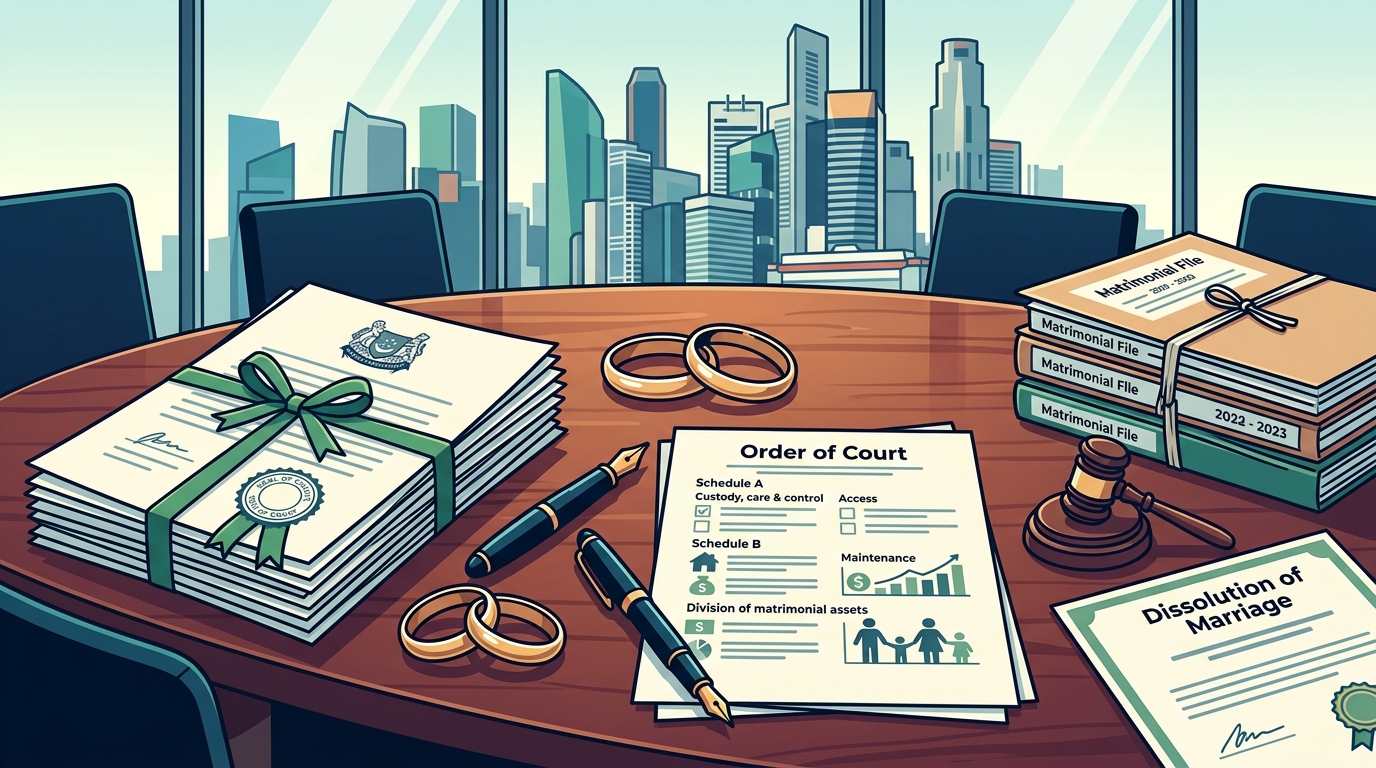
Step-by-Step Process
The journey to an uncontested divorce involves several distinct legal stages. Each stage requires precise documentation and adherence to court timelines.
1. Filing the Originating Petition
The process begins with the filing of an Originating Petition for Divorce. This document outlines the grounds for divorce and the proposed arrangements for children and assets. If you are handling this without legal counsel, you must ensure all forms are correctly filled out. However, given the complexity of legal terminology, many couples seek professional advice early on. You can explore our divorce lawyer services to understand how we assist with this initial filing.
2. The Interim Order
Once the petition is filed and served to your spouse, the court will review the case. If the grounds are proven and the spouse does not contest the divorce itself, the court will grant an Interim Order of Divorce. This order confirms that the marriage is legally dissolved, but it is not yet final.
3. The Final Order
After a waiting period of three months and one day from the Interim Order, you can apply for the Final Order of Divorce. This order makes the divorce absolute and legally binding. Only after the Final Order is granted are you free to remarry. The timeline from filing to the Final Order typically ranges from four to six months for uncontested cases, provided there are no delays in serving documents or resolving ancillary matters.
4. Ancillary Matters
While the divorce itself may be uncontested, the ancillary matters (children and assets) must be settled. If these are agreed upon, they can be incorporated into the court orders. If disputes arise later, the case may become contested. For guidance on asset division, see our insights on legal agreements and reviews which highlight the importance of clear documentation.
Costs and Legal Fees
One of the primary advantages of an uncontested divorce is the lower cost compared to litigation. However, expenses still apply. These include court filing fees, stamp duties, and legal fees if you engage a firm.
| Cost Component | Estimated Range (SGD) | Notes |
|---|---|---|
| Court Filing Fees | $104 - $205 | Depends on whether the petition is filed jointly or by one party. |
| Legal Fees (Uncontested) | $2,500 - $5,000 | Varies by firm complexity and whether ancillary matters are included. |
| Mediation Costs | $500 - $1,500 | If mediation is required for ancillary matters. |
It is crucial to clarify what is included in legal quotes. Some firms charge separately for drafting the Affidavit of Assets and Means. For transparent pricing and professional support, consider contacting IRB Law LLP for a consultation.
Frequently Asked Questions
Can I file for an uncontested divorce if my spouse lives overseas?
Yes, but the process is more complex. You must apply for substituted service, which allows the petition to be served via alternative methods if your spouse cannot be located. This may require additional legal steps and costs.
What happens if we agree on the divorce but disagree on child custody?
The divorce itself can still proceed as uncontested regarding the marital status. However, the court will not grant the Final Order until ancillary matters are resolved. You may need to attend mediation or litigation specifically for child arrangements.
Is legal representation mandatory for an uncontested divorce?
No, it is not mandatory. You can file as a litigant-in-person. However, given the legal risks of improper documentation, seeking advice is highly recommended. Our family law expertise covers both representation and advisory services.
How long does an uncontested divorce take?
Typically, it takes between four to six months from the date of filing to the Final Order, assuming no delays in serving documents or resolving ancillary issues.
Can I change my mind after filing?
Yes, you can withdraw the petition at any time before the Final Order is granted. However, if you wish to divorce later, you may need to file a new petition, potentially restarting the timeline.
What is the difference between a Deed of Separation and a divorce?
A Deed of Separation is a legal agreement where couples live apart but remain legally married. It does not dissolve the marriage. A divorce legally ends the marriage. For more on separation agreements, visit our Deed of Separation page.
Do I need to pay maintenance if I file for divorce?
Maintenance is determined by the court based on needs, resources, and standard of living. Even in an uncontested divorce, if you agree to pay maintenance, it must be formalized in court orders to be enforceable.
Secure Your Future with Professional Legal Support
Navigating the end of a marriage requires precision, empathy, and legal expertise. An uncontested divorce offers a path to closure, but only if handled correctly. At IRB Law LLP, we provide dedicated support to ensure your transition is as smooth and fair as possible. Our team specializes in family law, offering clear guidance on every step of the process.
Do not leave your legal future to chance. Contact us today to discuss your specific situation. Visit our Contact Us page to schedule a consultation with our experienced lawyers. We are here to help you move forward with confidence.