
Divorce in Singapore follows a simplified or a normal track depending on whether you and your spouse agree on divorce, the grounds for marriage dissolution and ancillary matters, such as child custody, maintenance and division of property. While you can get a divorce when your marriage has been irretrievably broken, even if your spouse doesn't agree, having an uncontested divorce can save significant time and costs and help to avoid a hostile adversarial process. Below, we discuss the divorce process and define the steps for contested vs uncontested divorce in Singapore to help you understand what to expect and make an informed decision on how to proceed.
Key Takeaways
- Getting a divorce in Singapore requires having a strong connection with the city-state, being married for at least 3 years unless you suffer exceptional hardship, and having your marriage irretrievably broken.
- If your marriage has been irretrievably broken, you can end it even if your spouse does not agree, which leads to a contested divorce.
- A contested divorce process includes case conferences and a trial, where you will have to stand up before the judge and present your evidence.
- At any stage of the contested process, you and your spouse can request uncontested proceedings, which can save considerable time and costs.
- Ancillary matters, such as child custody, maintenance, and property division, are often the most contentious parts of a divorce and require careful legal strategy.
- Engaging a specialist family lawyer early can help you navigate the complexities of both contested and uncontested proceedings effectively.
What Are the Key Requirements for Getting a Divorce
Before initiating any divorce proceedings, you must meet specific statutory requirements under the Women's Charter. These requirements apply to both contested and uncontested divorces and are the first hurdle you must clear before the court will accept your petition.
Jurisdiction and Eligibility
For the Singapore Courts to have jurisdiction, at least one of the spouses must be ordinarily resident in Singapore at the time the petition is filed. Additionally, the marriage must have taken place in Singapore or be recognized as valid under Singapore law. If you are an expatriate or have moved abroad, you may need to consider expat divorce in Singapore to ensure the correct jurisdiction is applied.
Duration of Marriage
You must have been married for at least three years before you can file for divorce. This is a strict rule, and the court will not grant a divorce if the marriage has lasted less than three years, unless you can demonstrate exceptional hardship or exceptional cruelty. This waiting period is designed to encourage couples to attempt reconciliation before making the final decision to end their marriage.
Irretrievable Breakdown
Irretrievable breakdown of marriage is the sole ground for divorce in Singapore. You must prove that the marriage has broken down beyond repair. The court accepts five facts as evidence of this breakdown: adultery, unreasonable behaviour, desertion for at least two years, living separately for at least three years, and living separately for at least four years (where the other party does not object). If you can prove any of these facts, the court will presume the marriage is irretrievably broken.
Understanding the Divorce Process in Singapore
The divorce process in Singapore is a multi-stage legal procedure that begins with the filing of a petition and ends with the final decree of divorce. Understanding the overall workflow helps you anticipate the timeline and costs involved. The process is generally divided into two main stages: the stage where the court grants the Decree Nisi, and the stage where the court grants the Decree Absolute.
Filing the Petition
The first step is to file a divorce petition with the Family Justice Courts. The petition must state the grounds for divorce and any ancillary matters you wish to address, such as custody of children or division of assets. Once filed, the petition is served on the other party, who then has the opportunity to respond. If they do not respond, the court may proceed in their absence, though this is rare in contested cases.
Decree Nisi and Decree Absolute
If the court is satisfied that the marriage has irretrievably broken down, it will grant a Decree Nisi. This is a provisional order that states the court is willing to dissolve the marriage. You must wait at least six weeks and one day after the Decree Nisi is granted before you can apply for the Decree Absolute. The Decree Absolute is the final order that legally ends the marriage. It is important to note that you cannot remarry until the Decree Absolute is granted.
What Is the Uncontested Divorce Process in Singapore
An uncontested divorce is a simplified procedure where both parties agree on the divorce and all ancillary matters. This is the most efficient and cost-effective way to end a marriage in Singapore. The process is designed to be as quick and painless as possible, allowing couples to move on with their lives without the stress of a trial.
Steps in Uncontested Divorce in Singapore
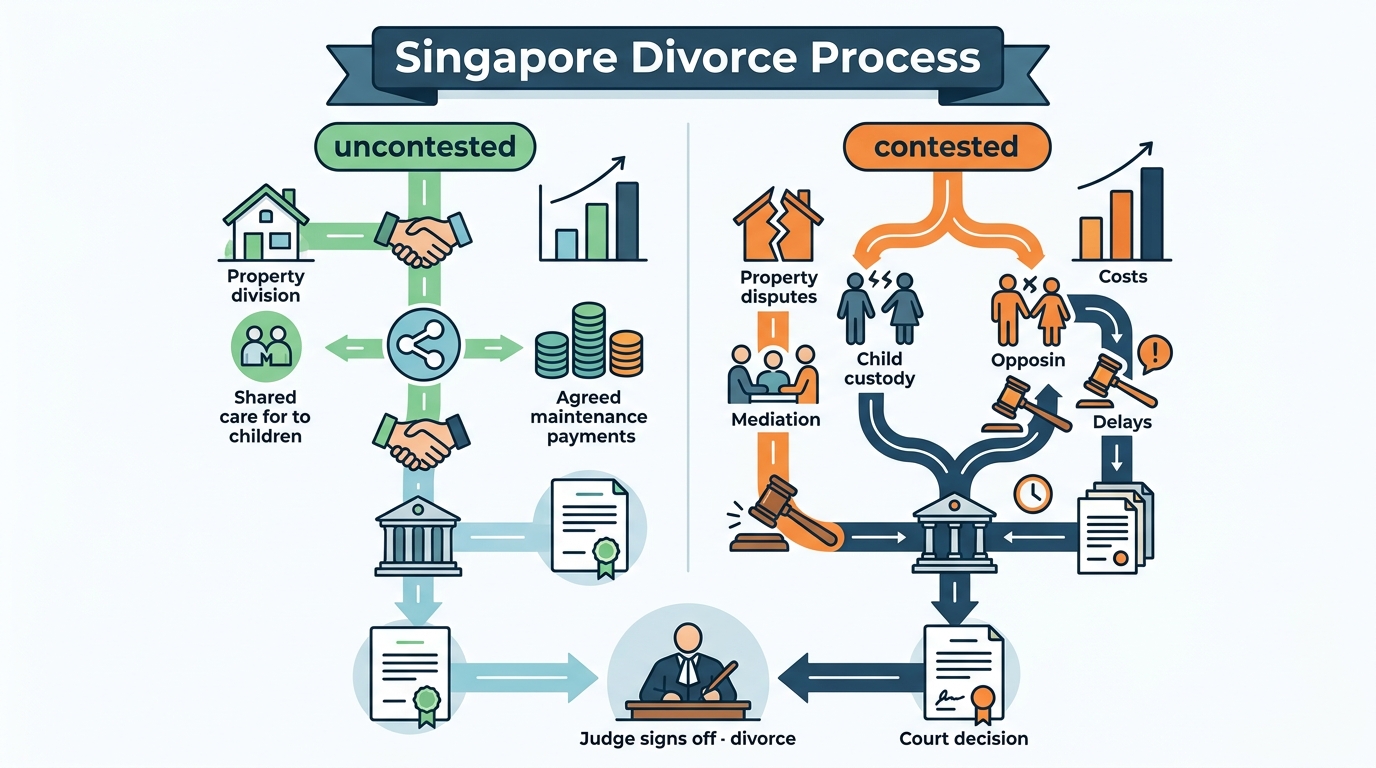
The uncontested divorce process involves several key steps. First, both parties must agree on the grounds for divorce and all ancillary matters, such as child custody, maintenance, and property division. This agreement is usually documented in a consent order. Next, the petitioner files the divorce petition, and the respondent files a consent to the petition. The court then reviews the documents and, if satisfied, grants the Decree Nisi. Finally, after the mandatory waiting period, the petitioner applies for the Decree Absolute, and the marriage is legally dissolved.
Benefits of Uncontested Divorce
Uncontested divorces offer several significant benefits. They are faster, typically taking a few months to complete, compared to a year or more for contested cases. They are also less expensive, as there is no need for a trial or extensive legal battles. Additionally, uncontested divorces are less stressful and allow couples to maintain a more amicable relationship, which is particularly important if they have children together. If you are considering this route, it is advisable to seek guidance from divorce lawyers in Singapore to ensure all agreements are legally sound and fair.
What Is the Contested Divorce Process in Singapore
A contested divorce occurs when one or both parties disagree on the divorce or any of the ancillary matters. This is a more complex and adversarial process that often involves multiple court hearings and a trial. Contested divorces are necessary when couples cannot reach an agreement on key issues, such as who gets custody of the children or how the marital assets should be divided.
Steps in Contested Divorce in Singapore
The contested divorce process begins with the filing of the petition and the respondent's opposition. The court then schedules a case conference, where the parties and their lawyers meet to discuss the issues and attempt to reach a settlement. If no settlement is reached, the case proceeds to a trial. At the trial, both parties present their evidence and arguments to the judge, who then makes a decision on the divorce and any ancillary matters. The process can take a significant amount of time, often over a year, and is considerably more expensive than an uncontested divorce.
Case Conferences and Trials
Case conferences are a crucial part of the contested divorce process. They are designed to encourage settlement and narrow down the issues in dispute. If the parties cannot reach a settlement, the case will proceed to a trial. At the trial, you will have to stand up before the judge and present your evidence. This can be a stressful and emotionally draining experience, which is why it is important to have experienced legal representation. Our team of lawyers is well-versed in the intricacies of contested divorce proceedings and can guide you through each step of the process.
Ancillary Matters Resolution
Ancillary matters are the financial and parental issues that arise during a divorce. These include child custody, care and control, maintenance, and the division of marital assets. Resolving these matters is often the most challenging part of a divorce, especially in contested cases. The court's primary objective in resolving ancillary matters is to ensure the best interests of the children and a fair division of assets.
Child Custody and Care and Control
Child custody refers to the legal right to make major decisions about a child's upbringing, such as education and healthcare. Care and control refers to the day-to-day physical custody of the child. In Singapore, the court typically grants joint custody and care and control to both parents, unless there are compelling reasons to do otherwise. If you are struggling to reach an agreement on these matters, you may want to consult with child custody lawyers in Singapore to explore your options.
Maintenance and Property Division
Maintenance is the financial support one spouse pays to the other after the divorce. The court considers several factors when determining maintenance, including the needs of the dependent spouse, the ability of the paying spouse to pay, and the standard of living during the marriage. Property division involves the equitable distribution of marital assets, such as the family home, savings, and investments. The court aims to achieve a fair and just division of assets, taking into account the contributions of both parties, both financial and non-financial. For more detailed information on these matters, you can refer to our guide on contested vs uncontested divorce in Singapore.
Frequently Asked Questions
How long does a contested divorce take in Singapore?
A contested divorce can take anywhere from six months to over a year, depending on the complexity of the case and the court's schedule. Uncontested divorces are typically faster, taking a few months to complete.
Can I change from a contested to an uncontested divorce?
Yes, at any stage of the contested process, you and your spouse can request uncontested proceedings if you reach an agreement on all issues. This can save considerable time and costs.
What happens if my spouse does not respond to the divorce petition?
If your spouse does not respond to the divorce petition, the court may proceed in their absence. However, this is rare in contested cases, and the court will usually make efforts to ensure the other party is properly served.
How is child custody determined in Singapore?
Child custody is determined based on the best interests of the child. The court considers factors such as the child's relationship with each parent, the parents' ability to care for the child, and the child's wishes, if they are of a sufficient age and maturity.
What is the difference between Decree Nisi and Decree Absolute?
Decree Nisi is a provisional order that states the court is willing to dissolve the marriage. Decree Absolute is the final order that legally ends the marriage. You must wait at least six weeks and one day after the Decree Nisi is granted before you can apply for the Decree Absolute.
Can I remarry after a Decree Nisi is granted?
No, you cannot remarry until the Decree Absolute is granted. The Decree Nisi is only a provisional order, and the marriage is not legally dissolved until the Decree Absolute is issued.
Conclusion
Navigating the legal steps for a contested versus uncontested divorce in Singapore requires a clear understanding of the requirements, processes, and potential outcomes. Whether you choose the simplified uncontested route or the more complex contested path, having the right legal support is crucial. At IRB Law LLP, we provide expert guidance and representation for all aspects of divorce proceedings, ensuring that your rights and interests are protected throughout the process. To discuss your specific situation and explore your options, please for a confidential consultation.