

How to Apply for a Grant of Probate or Letters of Administration in Singapore
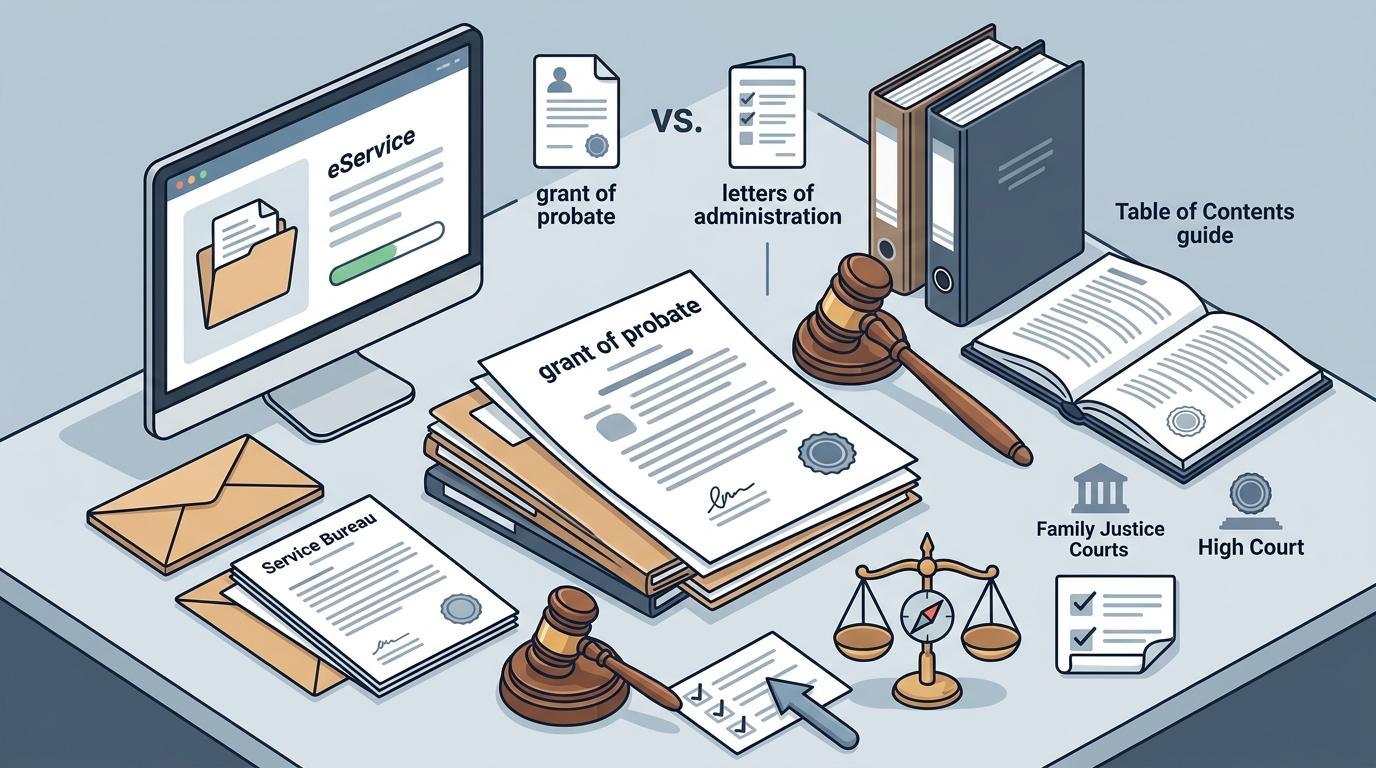
Applying for a Grant of Probate or Letters of Administration in Singapore is a formal court process that grants legal authority to manage a deceased person's estate. You must file an application with the Family Justice Courts or the High Court, depending on the estate's value. This guide covers the eligibility requirements, the difference between the two grants, the eService and Service Bureau filing options, and the step-by-step process for obtaining the court order.
Understanding the Grants: Probate vs. Letters of Administration
A Grant of Probate is a court order that authorizes the executors named in a valid will to manage and distribute the deceased's estate. It confirms the authenticity of the will and grants the executors legal authority to access bank accounts, sell property, and pay debts. In contrast, a Grant of Letters of Administration is issued when the deceased died intestate (without a will) or when the appointed executors are unable or unwilling to act. This grant appoints an administrator to handle the estate according to Singapore's intestacy laws.
When to Apply for Each Grant
You should apply for a Grant of Probate if the deceased left a valid will and you are named as an executor. If there is no will, or if the will is lost, or if the executors have renounced their role, you must apply for Letters of Administration. The choice of grant determines the legal framework for distributing the assets. Probate follows the specific instructions in the will, while Letters of Administration follow the statutory priority of beneficiaries under the Intestate Succession Act.
Legal Authority and Financial Institutions
Without a court order, financial institutions in Singapore are generally reluctant to release funds, even for small amounts. The grant serves as the primary proof of authority for banks, CPF Board, and land registries. It is essential for unblocking assets that are frozen upon the death of the account holder. The court order ensures that the person managing the estate is legally accountable for their actions.
Eligibility and Estate Value Thresholds
The jurisdiction for filing the application depends on the total value of the estate. If the estate value does not exceed $3 million, the application must be filed in the Family Justice Courts. If the estate value exceeds $3 million, the application must be filed in the Family Division of the High Court. This threshold is a critical first step in determining where to submit your documents and which court rules apply.
Small Estates and Public Trustee
If the estate value is less than $50,000 and there are no liabilities or unpaid debts, you may not need a court order. In such cases, you can apply to the Public Trustee to administer the estate. However, in practice, many financial institutions still require a court order or a specific Public Trustee certificate to release funds. It is advisable to check with the specific institutions holding the assets to confirm their requirements before deciding on the filing route.
Who Can Apply
For a Grant of Probate, the executors named in the will are the primary applicants. If there are multiple executors, they can apply jointly or one can apply on behalf of the others. For Letters of Administration, the priority of applicants is defined by law. Spouses, children, and other next of kin have specific ranks in the priority list. If the first in line is unable or unwilling to apply, the next in the priority order may apply. It is important to document the reasons for any higher-priority person's inability to act.
Probate eService Eligibility and Digital Filing
Singapore's courts have introduced digital filing options to streamline the probate process. The eService platform allows applicants to file certain probate applications electronically. This method is designed for straightforward cases where the estate is uncontested and the documentation is complete. Using eService can reduce the time spent on physical submissions and may speed up the initial processing of the application.
Eligibility for eService
Not all probate applications are eligible for eService filing. The system is typically available for applications where the estate value is below a certain threshold and where there are no caveats or objections from other parties. If the estate is complex, involves disputes, or exceeds the digital filing limits, you may need to use the traditional Service Bureau method. It is crucial to verify the current eligibility criteria on the court's official portal before attempting a digital submission.
Benefits of Digital Filing
Digital filing offers several advantages, including the ability to submit documents from home and receive electronic notifications of the court's progress. It also reduces the need for physical storage of paper documents. However, you must ensure that all digital files are clear, legible, and in the correct format. Errors in digital uploads can lead to delays, so it is important to double-check all documents before submission.
Service Bureau Filing and Physical Submission
The Service Bureau is the traditional method for filing court documents in Singapore. It involves submitting physical copies of the application forms, the will, the death certificate, and other supporting documents to the court's Service Bureau. This method is required for applications that are not eligible for eService or for those who prefer a physical submission. The Service Bureau is located at the Family Justice Courts and the High Court.
Preparing Physical Documents
When filing via the Service Bureau, you must prepare multiple copies of all documents. The court typically requires the original will, the original death certificate, and several photocopies of the application forms and schedules. The documents must be signed and witnessed according to legal requirements. It is advisable to use a lawyer to ensure that the physical documents meet all formatting and procedural standards to avoid rejection by the Service Bureau.
Submission and Receipt
After submitting the documents, you will receive a receipt and a case number. This case number is essential for tracking the progress of your application. You may need to attend a hearing if the court requires further clarification or if there are objections. The Service Bureau staff can provide guidance on the specific requirements for your case, but they cannot offer legal advice. For complex estates, engaging a legal professional is highly recommended.
Required Documents and Schedules
The application for a Grant of Probate or Letters of Administration requires a specific set of documents. These include the Originating Application, the Affidavit of the Executor or Administrator, the Will (for probate), the Death Certificate, and the Schedule of Assets. The Schedule of Assets is a detailed list of all the deceased's assets and liabilities, including bank accounts, property, investments, and debts. This schedule must be accurate and comprehensive.
Originating Application and Affidavit
The Originating Application is the formal request to the court for the grant. It must be signed by the applicant and witnessed by a Commissioner for Oaths or a lawyer. The Affidavit is a sworn statement that provides details about the deceased, the applicant's relationship to the deceased, and the value of the estate. It also confirms that the applicant is aware of their duties and responsibilities as an executor or administrator. These documents form the core of the application.
Supporting Documents
In addition to the core documents, you may need to provide other supporting documents, such as the death certificate, the will, and any caveats or objections. If the estate includes property, you may need to provide the title deeds or property statements. If the estate includes shares, you may need to provide the share certificates or statements from the company's registrar. All documents must be certified true copies if they are not originals. The court may require additional documents depending on the specific circumstances of the estate.
Step-by-Step Application Process
The process of obtaining a Grant of Probate or Letters of Administration involves several stages. First, you must gather all the necessary documents and prepare the application. Second, you must file the application with the court, either via eService or the Service Bureau. Third, the court will review the application and may schedule a hearing. Finally, if the court is satisfied, it will issue the grant. The entire process can take several weeks to several months, depending on the complexity of the estate and the court's schedule.
Stage 1: Preparation and Filing
Start by collecting the death certificate and the will. Prepare the Originating Application, the Affidavit, and the Schedule of Assets. File the application with the court and pay the required court fees. You will receive a case number and a hearing date if a hearing is required. It is important to file the application as soon as possible after the death to avoid delays in accessing the estate's assets.
Stage 2: Court Review and Hearing
The court will review the application to ensure that all requirements are met. If there are no objections, the court may issue the grant without a hearing. If there are objections or if the court requires further clarification, a hearing will be scheduled. At the hearing, the applicant may need to attend and answer questions from the judge. The judge will consider the evidence and decide whether to grant the application.
Stage 3: Issuance of the Grant
If the court approves the application, it will issue the Grant of Probate or Letters of Administration. The grant will be sealed by the court and sent to the applicant. You can then use the grant to access the estate's assets, pay debts, and distribute the remaining assets to the beneficiaries. It is important to keep the original grant in a safe place, as it may be required for future transactions or legal proceedings.
Key Takeaways
- A Grant of Probate is for estates with a will, while Letters of Administration are for intestate estates or when executors cannot act.
- Estate values under $3 million are filed in the Family Justice Courts; values over $3 million go to the High Court.
- Estate values under $50,000 with no debts may be handled by the Public Trustee, but banks may still require a court order.
- eService is available for eligible, uncontested cases, offering a faster digital filing option.
- The Service Bureau is the traditional physical filing method, requiring multiple copies of all documents.
- The Schedule of Assets must be accurate and comprehensive, listing all assets and liabilities.
- The process involves preparation, filing, court review, and issuance of the grant, which can take several weeks to months.
- Engaging a lawyer is recommended for complex estates to ensure compliance with legal requirements.
Frequently Asked Questions
What is the difference between a Grant of Probate and Letters of Administration?
A Grant of Probate is issued when the deceased left a valid will, authorizing the named executors to manage the estate. Letters of Administration are issued when there is no will, or when the executors are unable to act, appointing an administrator to manage the estate according to intestacy laws.
Where do I file the application if the estate is worth $2 million?
Can I apply for probate if I am not named in the will?
Generally, only the executors named in the will can apply for a Grant of Probate. If you are not named, you may need to apply for Letters of Administration if you are a beneficiary or next of kin, depending on the circumstances.
How long does the probate process take in Singapore?
The probate process can take several weeks to several months, depending on the complexity of the estate, the court's schedule, and whether there are any objections or disputes.
Do I need a lawyer to apply for probate?
While it is possible to apply for probate without a lawyer, it is highly recommended for complex estates. A lawyer can help ensure that all documents are correctly prepared and that the application meets all legal requirements.
What happens if the estate has debts?
If the estate has debts, the executor or administrator must use the estate's assets to pay off the debts before distributing the remaining assets to the beneficiaries. The debts must be listed in the Schedule of Assets.
Can I use eService for all probate applications?
No, eService is only available for eligible, uncontested cases. Complex estates or those with objections may need to use the traditional Service Bureau filing method.
What is the role of the Public Trustee in probate?
The Public Trustee can administer small estates (under $50,000) with no debts. However, financial institutions may still require a court order or a specific certificate from the Public Trustee to release funds.
Conclusion
Applying for a Grant of Probate or Letters of Administration in Singapore is a critical step in managing a deceased person's estate. Understanding the differences between the two grants, the eligibility requirements, and the filing options is essential for a smooth process. Whether you choose the digital eService or the traditional Service Bureau, ensuring that your documents are accurate and complete is key to avoiding delays. For complex estates or if you are unsure about the legal requirements, consulting with a legal professional is highly recommended. IRB Law LLP offers expert guidance on probate and letters of administration, helping you navigate the court process with confidence and efficiency.