

For Muslim families in Singapore, navigating the intersection of faith and statutory law is a critical life event. The Administration of Muslim Law Act (AMLA) governs these matters, ensuring that religious principles are applied within the national legal framework. According to recent legal analyses, the Syariah Court handles over 90% of Muslim divorce cases in Singapore, highlighting the system's central role in community welfare. Understanding the precise mechanisms for divorce and inheritance is not merely a religious obligation but a legal necessity to protect your family's future.
The Syariah Divorce Process Explained
Divorce in Singapore for Muslims is exclusively handled by the Syariah Court. Unlike civil marriages registered under the Women's Charter, Muslim marriages are registered with the Registry of Muslim Marriages (ROMM). This distinction dictates the legal pathway for dissolution.
Types of Divorce
The primary method is Talak, where the husband pronounces divorce. However, the court must approve the divorce to ensure all ancillary matters are settled. Another common route is Khula, where the wife initiates the divorce, often by returning her dower (mahr). A third option is Musarakat al-Khil', a mutual agreement divorce where both parties consent to the separation.
Procedural Steps
The process begins with filing an application at the Syariah Court. The court mandates a mandatory counseling session through the Religious Rehabilitation Group (RRG) or a certified counselor. This step is designed to explore reconciliation options before proceeding with the dissolution. If reconciliation fails, the court schedules hearings to address ancillary matters such as custody, maintenance, and the division of assets.
For expatriates or those with complex cross-border elements, the jurisdiction of the Syariah Court is determined by the domicile of the parties. If one party is domiciled in Singapore, the court typically has jurisdiction. This is particularly relevant for cross-border financial disputes that often accompany international divorces.
Ancillary Matters
The court does not automatically divide assets equally. Instead, it considers factors such as the contribution of each party, the needs of the children, and the standard of living enjoyed during the marriage. Custody (hadhanah) is typically granted to the mother for young children, but care and control may be awarded to either parent based on the child's best interests.
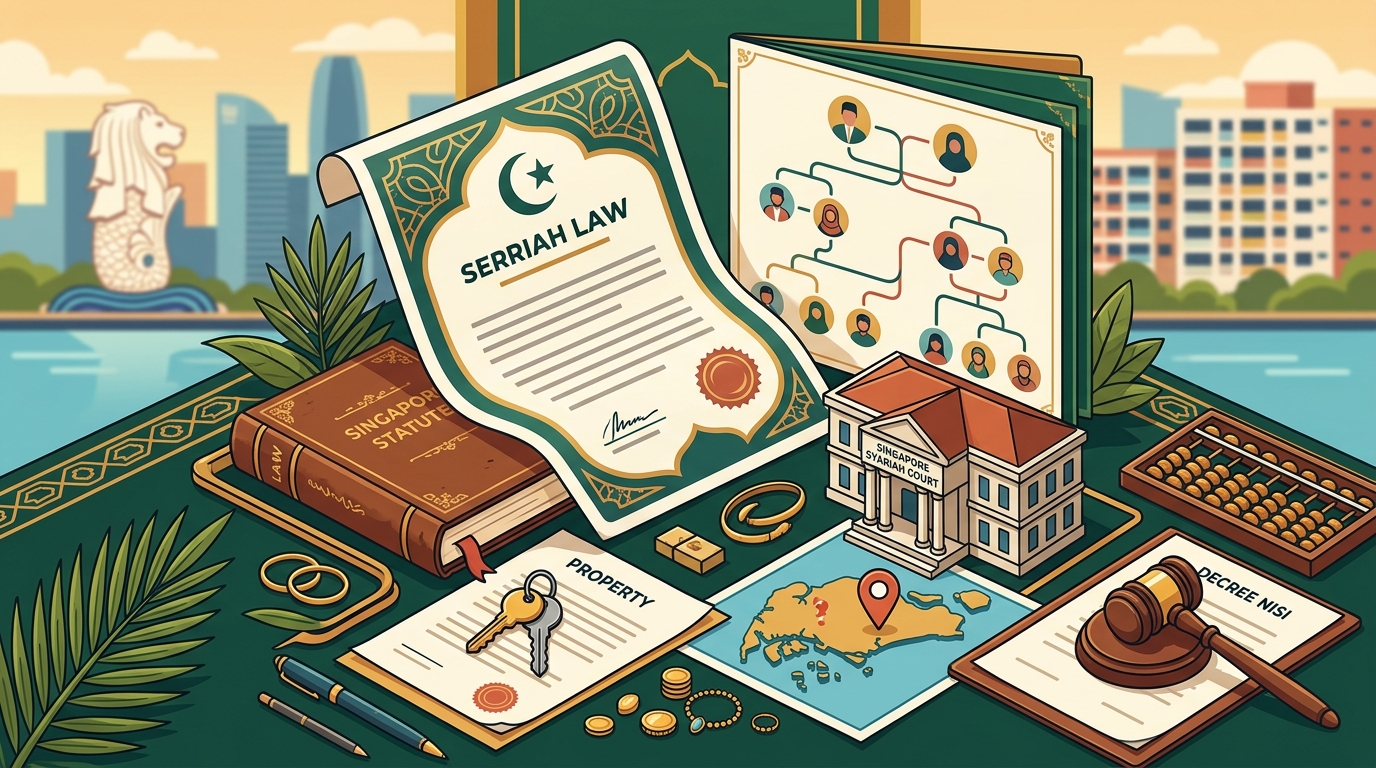
Understanding Faraid: The Law of Inheritance
Faraid is the Islamic law of inheritance that dictates the distribution of a deceased Muslim's estate. It is a mandatory statutory framework in Singapore under AMLA. Unlike civil wills, where you can distribute assets to anyone, Faraid assigns fixed shares to specific heirs based on their relationship to the deceased.
Who Are the Heirs?
The primary heirs are classified into two categories: primary heirs (ashab al-faraid) and secondary heirs (residuary heirs). Primary heirs include spouses, parents, and children. Their shares are fixed by the Quran. For example, a husband typically receives one-fourth of the estate if the deceased has children. A wife receives one-eighth in the same scenario.
If there are no primary heirs, the estate may pass to secondary heirs such as grandparents or siblings. The complexity arises when multiple heirs with overlapping claims exist. For instance, if the deceased is survived by a wife, a mother, and two daughters, the distribution requires precise calculation to ensure no heir is excluded or over-allocated.
The Role of the Public Trustee
In cases where heirs cannot be located or there is a dispute, the Public Trustee may be appointed to manage the estate. This ensures that the assets are preserved and distributed according to Faraid principles. IRB Law LLP provides specialized estate planning services to help clients navigate these complexities before they arise.
Wasiat and Hibbah: Alternative Distribution Methods
While Faraid is mandatory, Islamic law allows for two mechanisms to distribute assets outside the standard Faraid shares: Wasiat and Hibbah.
Wasiat (Islamic Will)
A Muslim in Singapore can only distribute up to one-third of their net estate via a Wasiat. The remaining two-thirds must be distributed according to Faraid. This one-third can be given to non-heirs, such as charities, friends, or distant relatives. It is crucial to ensure that the Wasiat does not infringe upon the fixed shares of the primary heirs.
Creating a valid Wasiat requires strict adherence to legal formalities. The will must be in writing, signed by the testator, and witnessed by two competent Muslims. IRB Law LLP assists clients in drafting wills that comply with both Islamic principles and Singaporean law.
Hibbah (Gift During Lifetime)
Hibbah allows a Muslim to gift assets during their lifetime. Unlike Wasiat, which takes effect upon death, Hibbah transfers ownership immediately. However, the gift must be complete and unconditional. The donor must deliver the asset to the donee, and the donee must accept it. This is often used for property transfers or financial support for children.
Caution is advised when using Hibbah to avoid disputes. If the gift is deemed to be a sham or if it prejudices the rights of heirs, it may be challenged in court. Proper documentation and legal advice are essential to ensure the validity of the Hibbah.
Key Differences: Divorce vs. Inheritance
Understanding the distinction between divorce and inheritance processes is vital for effective legal planning. The following table summarizes the key differences.
| Feature | Syariah Divorce | Syariah Inheritance (Faraid) |
|---|---|---|
| Governing Law | Administration of Muslim Law Act (AMLA) | Administration of Muslim Law Act (AMLA) |
| Court | Syariah Court | Syariah Court (for grant of probate) |
| Asset Distribution | Based on contribution and needs | Fixed shares per Faraid rules |
| Will Validity | Wills do not apply to Muslim estates | Wills limited to one-third of estate |
| Key Procedure | Mandatory counseling and ancillary hearings | Letter of Administration or Grant of Probate |
For those dealing with financial scams or debt recovery issues, these legal processes can become even more complex. Ensuring that your estate is protected from external liabilities is a critical part of the planning process.
Key Takeaways
- Jurisdiction: All Muslim divorces and inheritance matters in Singapore are governed by the Syariah Court under AMLA.
- Faraid is Mandatory: You cannot bypass Faraid for the majority of your estate. Only one-third can be distributed via a Wasiat.
- Counseling is Required: Mandatory counseling is a prerequisite for divorce, aimed at reconciliation and amicable settlement.
- Wasiat Limits: A Wasiat can only benefit non-heirs or be used to give more than the Faraid share to a heir, up to one-third of the net estate.
- Hibbah Risks: Lifetime gifts must be complete and unconditional to avoid being challenged by heirs later.
- Legal Expertise: Navigating these processes requires specialized knowledge of both Islamic law and Singaporean statutory requirements.
- IRB Law LLP: Our team provides comprehensive support for Syariah law matters, ensuring your rights and religious obligations are upheld.
Frequently Asked Questions
Can a Muslim in Singapore make a will that overrides Faraid?
No. A Muslim in Singapore can only distribute up to one-third of their net estate via a Wasiat. The remaining two-thirds must be distributed according to the fixed shares of Faraid. Any attempt to override Faraid for the majority of the estate is invalid under Singapore law.
What happens if there is no will for a Muslim who dies in Singapore?
If there is no valid Wasiat, the estate is distributed entirely according to Faraid. The Syariah Court will issue a Letter of Administration to the appropriate heir, who will then manage the distribution. This process ensures that all statutory and religious requirements are met.
Is counseling mandatory for Muslim divorce in Singapore?
Yes. Before a divorce can be granted, both parties must attend mandatory counseling sessions. This is designed to explore reconciliation options and ensure that ancillary matters are addressed amicably. The counseling is conducted by certified counselors or the Religious Rehabilitation Group.
How does Hibbah differ from Wasiat?
Hibbah is a gift given during the donor's lifetime, while Wasiat is a will that takes effect upon death. Hibbah transfers ownership immediately, whereas Wasiat only distributes assets after the testator's death. Both are subject to legal scrutiny to ensure validity and fairness.
Can non-Muslims inherit from a Muslim estate in Singapore?
Generally, no. Under Faraid, non-Muslims are not considered heirs. However, a Muslim can use their one-third Wasiat share to gift assets to non-Muslim relatives or charities. This is a common way to provide for non-Muslim family members while complying with Islamic law.
What is the role of the Syariah Court in inheritance matters?
The Syariah Court grants the Letter of Administration or Grant of Probate for Muslim estates. It ensures that the distribution follows Faraid principles and that all debts and funeral expenses are paid first. The court also resolves disputes among heirs regarding the distribution of assets.
How can IRB Law LLP assist with Syariah law matters?
IRB Law LLP provides specialized legal advice on Syariah divorce, Faraid inheritance, and Wasiat and Hibbah planning. Our team helps clients draft compliant wills, navigate court procedures, and resolve disputes efficiently.
Contact IRB Law LLP
Navigating Syariah law in Singapore requires precision, empathy, and deep legal expertise. Whether you are planning your estate, facing a divorce, or dealing with inheritance disputes, IRB Law LLP is here to support you. We provide confidential, professional advice tailored to your unique circumstances.
Do not wait until it is too late. Secure your family's future today. Contact IRB Law LLP to schedule a consultation with our experienced Syariah law specialists. Let us help you navigate these complex waters with confidence and clarity.