

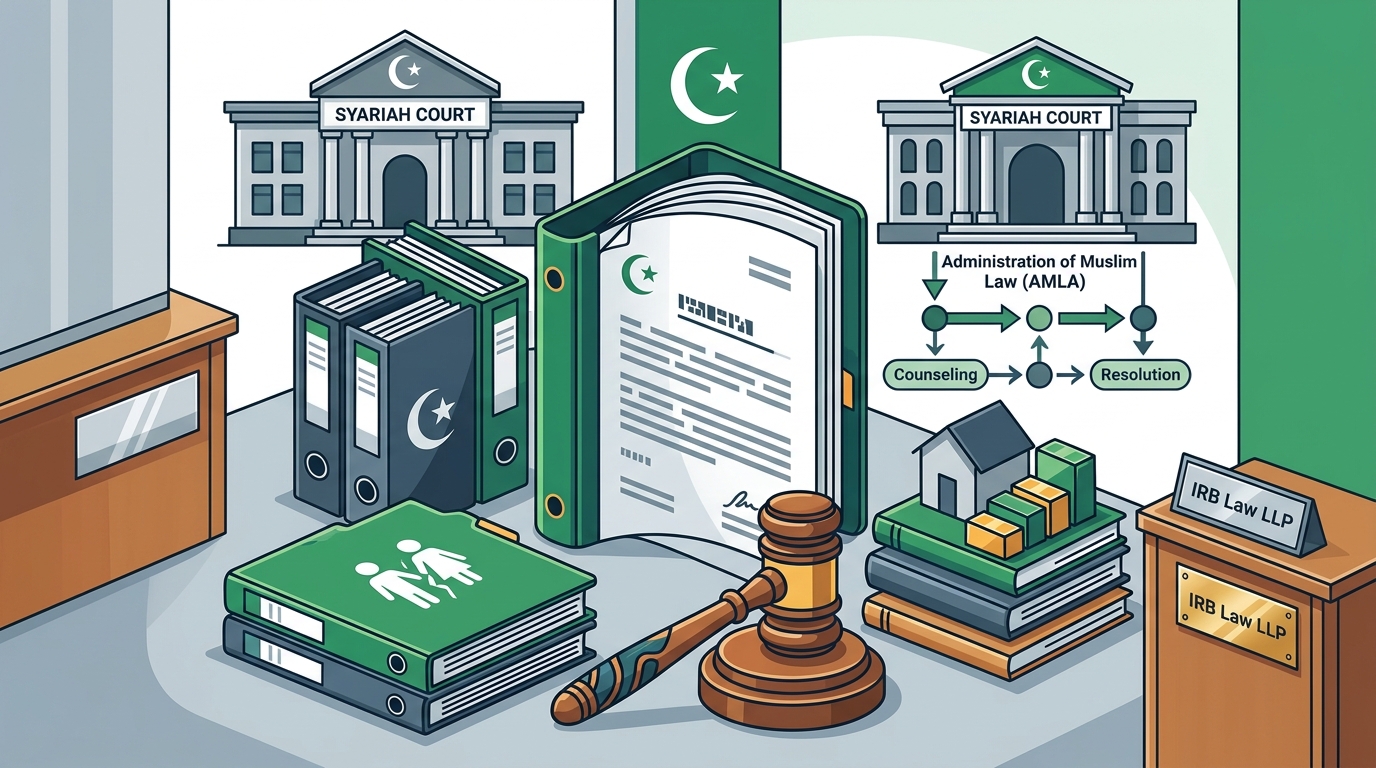
For Muslim residents in Singapore, family law operates within a distinct legal framework separate from the civil courts. The administration of Islamic family matters is governed by the Administration of Muslim Law Act (AMLA) and overseen by the Syariah Court. Recent data indicates that the Syariah Court handles thousands of cases annually, ranging from divorce proceedings to complex inheritance disputes. Understanding these processes is critical for ensuring compliance with religious obligations and legal requirements. This guide details the procedural pathways for both divorce and inheritance under Singapore’s Syariah law.
Understanding the Syariah Legal Framework
Syariah law in Singapore is not a monolithic code but a structured system derived from the Quran and the Sunnah, interpreted through the Shafi’i school of jurisprudence, which is the predominant school followed in Southeast Asia. The Syariah Court is the specialized judicial body with jurisdiction over Muslims in matters of marriage, divorce, inheritance, and religious observance. (Power of Attorney in)
Syariah law is the body of religious law that governs the private and public lives of Muslims. In Singapore, its application is strictly limited to personal law matters and does not extend to criminal or commercial law for non-Muslims. The Syariah Court operates alongside the State Courts and the High Court, but its jurisdiction is exclusive to Muslims in specific domains. (Top Law Firm in)
For many families, navigating this dual legal system can be confusing. Civil law governs property division in some contexts, while Syariah law dictates the religious validity of the divorce and the distribution of assets according to Islamic principles. It is essential to engage legal counsel who understands the intersection of these two systems to avoid conflicting judgments.
The Process of Syariah Divorce
Initiating a divorce in the Syariah Court requires adherence to specific procedural steps designed to encourage reconciliation and ensure fairness. The process begins with the filing of a Widjiah (Statement of Claim) by the party seeking the divorce, known as the plaintiff.
Before the court can grant a divorce, the parties must typically undergo mandatory counseling through the Religious Council (Muis) or the Syariah Court’s counseling unit. This step is crucial as it aims to explore the possibility of reconciliation. If reconciliation fails, the case proceeds to mediation. Only after these avenues are exhausted can the court adjudicate the divorce.
The timeline for a divorce can vary significantly depending on the complexity of the case, particularly regarding child custody and asset division. According to recent legal reports, uncontested divorces may take several months, while contested cases can extend over a year or more. The court prioritizes the welfare of children and the financial security of the wife, ensuring that maintenance and custody arrangements are fair.
Types of Divorce Under Syariah Law
Syariah law recognizes several types of divorce, each with distinct legal implications and procedural requirements. Understanding these distinctions is vital for determining the correct legal pathway.
Khula Divorce
Khula is a divorce initiated by the wife. In this process, the wife typically offers compensation to the husband, often in the form of returning the dowry (mahar), in exchange for his consent to the divorce. If the husband agrees, the divorce is granted. If he refuses, the wife may petition the Syariah Court to intervene. The court will then assess whether the marriage has broken down irretrievably and whether the compensation is fair.
Mubarat Divorce
Mubarat is a mutual divorce where both parties agree to separate. This is often the quickest and least contentious form of divorce. Both parties waive their rights to certain claims, such as deferred dowry or maintenance, to facilitate a clean break. The court reviews the agreement to ensure it is voluntary and fair before granting the decree.
Fasakh Divorce
Fasakh is a judicial divorce granted by the court on specific grounds, such as desertion, failure to provide maintenance, or cruelty. The wife does not need the husband’s consent for a Fasakh divorce. However, she must provide substantial evidence to support her claims. The court acts as the arbitrator, ensuring that the grounds for divorce meet the strict legal thresholds defined under AMLA.
Inheritance and the Faraid System
Upon the death of a Muslim in Singapore, their estate is distributed according to the Faraid system. Faraid is the Islamic law of inheritance that prescribes fixed shares for specific categories of heirs. This system is mandatory and cannot be overridden by a will for the portion of the estate subject to Faraid.
Faraid is the Islamic legal framework that determines the distribution of a deceased Muslim’s estate among eligible heirs. The shares are calculated based on the relationship of the deceased to the surviving family members, including spouses, parents, and children.
The process begins with the settlement of the deceased’s debts and funeral expenses. The remaining estate is then divided according to the prescribed ratios. For example, a husband typically receives one-eighth of the estate if the deceased has children. The distribution can become complex in cases involving multiple spouses, adopted children (who are not legal heirs under Faraid), or distant relatives.
It is common for families to seek a Letter of Administration (LPA) or Grant of Probate from the Syariah Court to legally administer the estate. Without these legal instruments, banks and property boards will not release assets to the heirs. IRB Law LLP assists clients in navigating these administrative hurdles to ensure a smooth transition of assets.
Wasiat and Hibbah: Alternative Distributions
While Faraid governs the majority of the estate, Muslims in Singapore have two mechanisms to distribute assets outside of these fixed shares: Wasiat and Hibbah.
Wasiat (Will)
Wasiat is the Islamic equivalent of a will. A Muslim can allocate up to one-third of their net estate to non-Faraid heirs, such as charities, friends, or non-Muslim relatives. The remaining two-thirds must be distributed according to Faraid. It is crucial that the Wasiat is drafted correctly to avoid legal challenges. A poorly drafted will can lead to disputes and prolonged litigation in the Syariah Court.
Wasiat is a legal instrument that allows a Muslim to bequeath up to one-third of their estate to beneficiaries who are not entitled to a share under Faraid. This tool provides flexibility for charitable giving or supporting dependents who do not qualify for statutory inheritance.
Hibbah (Gift)
Hibbah is a gift made during the donor’s lifetime. Unlike Wasiat, which takes effect upon death, Hibbah transfers ownership immediately. To be valid, the gift must be unconditional, and the donor must physically or constructively deliver the asset to the donee. Hibbah is often used for estate planning to reduce the taxable estate or to provide for a child early in life.
However, Hibbah can be revoked under certain conditions, such as if the donee treats the donor poorly. This revocability makes it a less secure tool for long-term estate planning compared to Wasiat. Legal advice is recommended to ensure the Hibbah is irrevocable and legally binding.
Key Takeaways
- Jurisdiction: The Syariah Court has exclusive jurisdiction over Muslim family law matters in Singapore, including divorce and inheritance.
- Divorce Types: Khula, Mubarat, and Fasakh are the primary routes to divorce, each with distinct requirements for consent and evidence.
- Faraid Mandatory: The Faraid system dictates the distribution of up to two-thirds of a Muslim’s estate, leaving only one-third available for Wasiat.
- Legal Documentation: Grants of Probate or Letters of Administration are required to access bank accounts and property for deceased Muslims.
- Professional Guidance: Navigating the intersection of Syariah law and civil property law requires specialized legal expertise to avoid conflicting claims.
- Reconciliation: Mandatory counseling is a prerequisite for most divorce proceedings, emphasizing the court’s role in preserving family unity.
- Wasiat Limits: A Wasiat cannot override Faraid shares for legal heirs and is limited to one-third of the net estate.
Frequently Asked Questions
Can a Muslim in Singapore make a will that overrides Faraid?
No. A Muslim can only bequeath up to one-third of their net estate via Wasiat. The remaining two-thirds must be distributed according to the Faraid system to legal heirs.
What is the difference between Khula and Fasakh divorce?
Khula is a divorce initiated by the wife with the husband’s consent, often involving compensation. Fasakh is a judicial divorce granted by the court on specific grounds without the husband’s consent.
Do I need a lawyer for a Syariah divorce?
While not strictly mandatory, legal representation is highly recommended, especially in contested cases involving child custody or asset division, to ensure your rights are protected.
How is the inheritance distributed if there are no children?
If there are no children, the spouse and parents typically receive larger shares. The exact distribution depends on the presence of other relatives, such as siblings or grandparents.
Can a non-Muslim inherit from a Muslim under Syariah law?
Generally, no. Non-Muslims are not eligible to inherit under Faraid. However, they can receive a bequest through Wasiat, up to the one-third limit.
What is the role of the Religious Council in divorce?
The Religious Council conducts mandatory counseling to explore reconciliation. If reconciliation fails, they issue a certificate allowing the case to proceed to the Syariah Court.
How long does it take to get a Grant of Probate in the Syariah Court?
The timeline varies based on the complexity of the estate and the cooperation of heirs. Uncontested cases may take a few months, while contested cases can take longer.
Contact IRB Law LLP
Navigating Syariah law in Singapore requires precision and deep legal expertise. Whether you are planning your estate, seeking a divorce, or administering an inheritance, IRB Law LLP provides trusted legal counsel. Our team specializes in family law, probate, and corporate advisory services tailored to the unique needs of Muslim clients in Singapore.
For expert guidance on Syariah divorce, inheritance planning, or estate administration, contact IRB Law LLP today to schedule a consultation. We are committed to providing integrity-driven legal solutions that protect your interests and uphold your religious values.