

Understanding the intersection of faith and law is critical for Singapore's Muslim community. According to recent data from the Syariah Court, the number of Muslim divorces in Singapore has fluctuated, with over 2,000 cases recorded annually in recent years, highlighting the necessity for clear legal guidance. This guide explains how Syariah law processes work for Muslim divorce and inheritance, ensuring you are prepared for the legal and financial implications.
What is Syariah Law?
Syariah law is the religious legal system derived from the Quran and the Hadith, which governs the personal law of Muslims in Singapore. It covers areas such as marriage, divorce, inheritance, and religious obligations. In Singapore, the administration of Syariah law is overseen by the Syariah Court and the Administration of Muslim Law Act (AMLA).
For Muslims in Singapore, AMLA is the primary legislation that regulates Muslim affairs. It establishes the framework for the Syariah Court and defines the jurisdiction of matters that fall under Syariah law. Understanding these boundaries is essential for anyone navigating family law or estate planning.
IRB Law LLP provides specialized legal counsel in this niche area. We help clients navigate the complexities of Syariah Law with precision and empathy. Our team understands the delicate balance between religious principles and legal requirements.
The Syariah Divorce Process
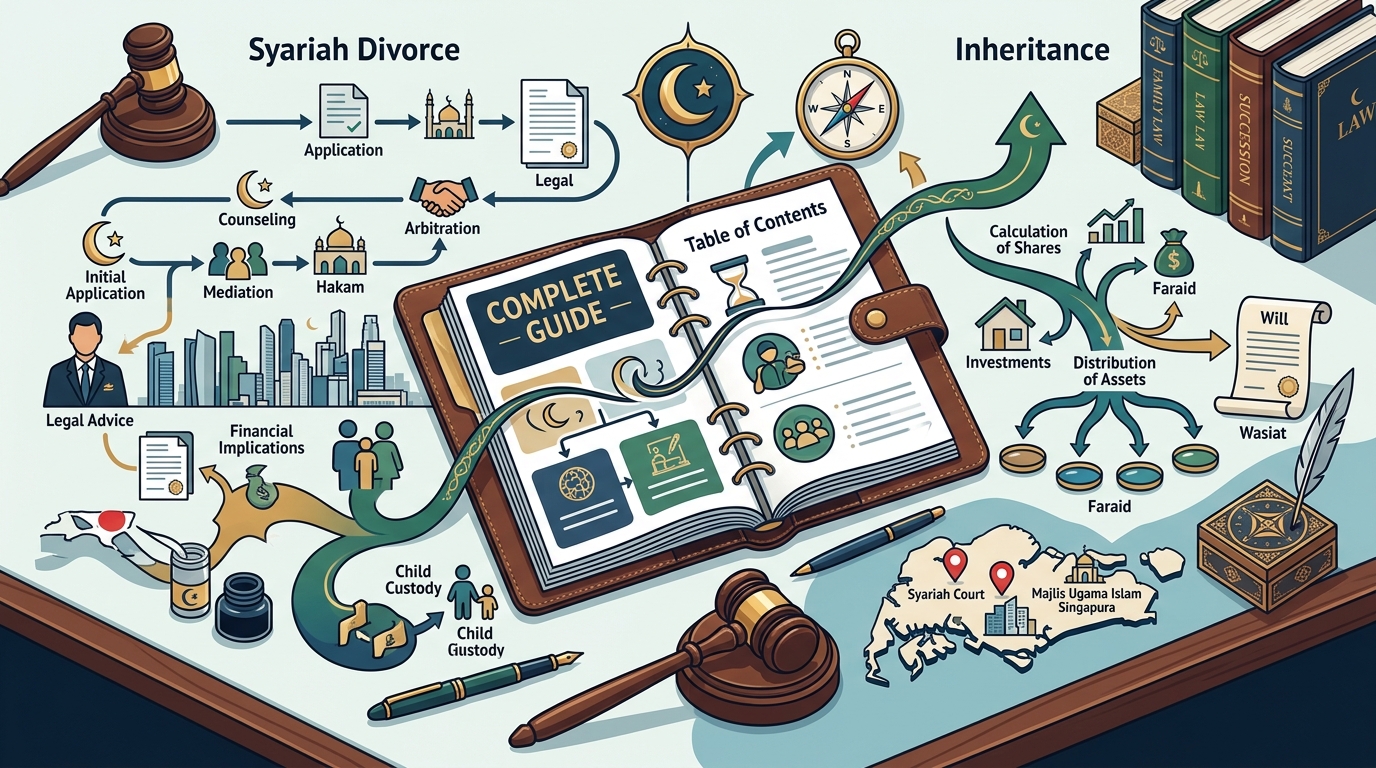
Divorce in the Syariah Court is a structured legal process. It is not merely a religious ceremony but a legal procedure that must be finalized to ensure the dissolution of marriage is recognized by the state. The process typically involves several key stages.
1. Filing for Divorce
The process begins with the filing of a suit in the Syariah Court. The grounds for divorce can vary, including irretrievable breakdown of marriage, failure to provide maintenance, or cruelty. Each ground requires specific evidence and documentation.
For expatriates or those with cross-border elements, the process can be more complex. Expat Divorce cases require careful handling of jurisdictional issues and international legal recognition.
2. Mediation and Counseling
Singapore law mandates that parties undergo counseling and mediation before the court can grant a divorce. This step is designed to encourage reconciliation where possible. The counseling is conducted by accredited counselors who assess the possibility of saving the marriage.
If reconciliation fails, the court proceeds to hear the case. The judge will review the evidence and determine if the grounds for divorce are met.
3. Ancillary Matters
Once the divorce is granted, the court addresses ancillary matters. These include:
- Custody and Care and Control: Determining who has the primary responsibility for the children.
- Maintenance: Calculating the amount of financial support for the ex-spouse and children.
- Asset Division: While Syariah law does not have a strict equal division principle like civil law, the court considers contributions and needs.
IRB Law LLP assists clients in Custody and Care and Control cases to ensure the best interests of the children are protected. We also handle Maintenance disputes to ensure fair financial outcomes.
Faraid: The Law of Inheritance
Faraid is the Islamic law of inheritance that dictates how the estate of a deceased Muslim is distributed. It is a mandatory legal framework in Singapore for Muslims. Unlike civil wills, Faraid does not allow a Muslim to distribute their entire estate according to personal wishes. Instead, it assigns fixed shares to specific heirs.
The heirs are categorized into primary and secondary groups. Primary heirs include the spouse, parents, and children. Secondary heirs include siblings and grandparents. The distribution depends on the surviving heirs and their relationship to the deceased.
For example, if a deceased leaves behind a spouse and children, the spouse receives a fixed portion, and the remainder is distributed among the children. The specific shares are calculated based on complex formulas defined in Islamic jurisprudence.
IRB Law LLP offers specialized Faraid – Muslim Inheritance services. We help families understand their entitlements and resolve disputes that may arise during the distribution process.
Wasiat: Muslim Wills in Singapore
While Faraid governs the majority of the estate, a Muslim can distribute up to one-third of their estate through a Wasiat, or Islamic will. This allows for flexibility in leaving assets to non-heirs, such as charities, friends, or institutions.
Creating a Wasiat is crucial for ensuring that your wishes are respected within the bounds of Syariah law. The will must be executed in accordance with Islamic principles and registered with the Syariah Court.
IRB Law LLP provides comprehensive Wasiat & Hibbah – Muslim Wills services. Our team ensures that your will is legally valid and religiously compliant.
Hibbah: Inter Vivos Gifts
Hibbah refers to gifts made during one's lifetime. It is a common method for Muslims in Singapore to transfer assets, such as property or cash, to family members or charities. Unlike inheritance, Hibbah takes effect immediately upon delivery.
However, Hibbah must be executed with caution. It must be genuine, voluntary, and delivered to the recipient. If challenged, the gift can be contested in court. Proper documentation and legal advice are essential to prevent future disputes.
IRB Law LLP assists with Hibbah arrangements to ensure they are legally sound and effectively transfer ownership.
IRB Law LLP Services
IRB Law LLP is a leading law firm in Singapore specializing in Syariah law. Our team of experienced lawyers provides expert advice on a wide range of matters, including:
- Syariah Divorce
- Faraid – Muslim Inheritance
- Wasiat & Hibbah – Muslim Wills
- Probate & Letters of Administration
- Estate Planning
We are committed to providing compassionate and effective legal solutions. Our approach is tailored to the unique needs of each client, ensuring that their rights and interests are protected.
Key Takeaways
- Syariah law in Singapore is governed by the Administration of Muslim Law Act (AMLA).
- Divorce in the Syariah Court requires mediation and counseling before finalization.
- Faraid mandates fixed inheritance shares for Muslim heirs, limiting the ability to write a full civil will.
- Up to one-third of a Muslim's estate can be distributed via a Wasiat (Islamic will).
- Hibbah allows for lifetime gifts but requires strict legal formalities to be valid.
- IRB Law LLP specializes in Syariah law, offering expertise in divorce, inheritance, and estate planning.
- Legal counsel is essential for navigating the complexities of Syariah law and ensuring compliance.
Frequently Asked Questions
What is the difference between Syariah divorce and civil divorce?
Syariah divorce is governed by Islamic law and the Syariah Court, while civil divorce is governed by the Women's Charter and the Family Courts. Muslims must obtain a Syariah divorce for their marriage to be dissolved under religious law.
Can a Muslim write a will in Singapore?
Yes, a Muslim can write a Wasiat (Islamic will) to distribute up to one-third of their estate. The remaining two-thirds are distributed according to Faraid.
What is Faraid?
Faraid is the Islamic law of inheritance that dictates the distribution of a deceased Muslim's estate among their heirs based on fixed shares.
How does Hibbah work?
Hibbah is a gift made during one's lifetime. It must be delivered to the recipient and is effective immediately. It is often used to transfer property or assets to family members.
Do I need a lawyer for Syariah matters?
While not mandatory, having a lawyer is highly recommended. Legal counsel ensures that your rights are protected and that all procedures are followed correctly.
What is the role of the Syariah Court?
The Syariah Court handles matters of personal law for Muslims, including marriage, divorce, inheritance, and religious offenses.
How can IRB Law LLP help?
IRB Law LLP provides specialized legal services in Syariah law, including divorce, inheritance, and estate planning. We offer expert advice and representation.
Contact IRB Law LLP
If you are navigating Syariah law matters, do not face them alone. IRB Law LLP is here to help. Our team of experienced lawyers is ready to provide you with the guidance and support you need.
Contact us today to schedule a consultation. We are available Mon – Fri: 9:30am – 6pm and Sat – Sun: By Appointment.
Contact IRB Law LLP for expert legal assistance.