

Mounting debts can feel paralysing, but Singapore's legal framework actually provides multiple pathways — not just bankruptcy — for individuals to regain financial stability. This guide walks you through every major option, from informal negotiations to formal bankruptcy filings, so you can make an informed decision about the route that best fits your circumstances.
The Legal Framework: Understanding the IRDA
Singapore's personal insolvency regime is governed by the Insolvency, Restructuring and Dissolution Act 2018 (IRDA), which came into force on 30 July 2020 and replaced the former Bankruptcy Act. The IRDA consolidates personal and corporate insolvency law into a single statute, streamlining both procedures and protections.
Notably, Singapore's insolvency regime is generally regarded as debtor-friendly, balancing strict legal obligations with allowing individuals to maintain an acceptable standard of living and recover from financial setbacks.
Before You Consider Bankruptcy: Alternatives Worth Exploring
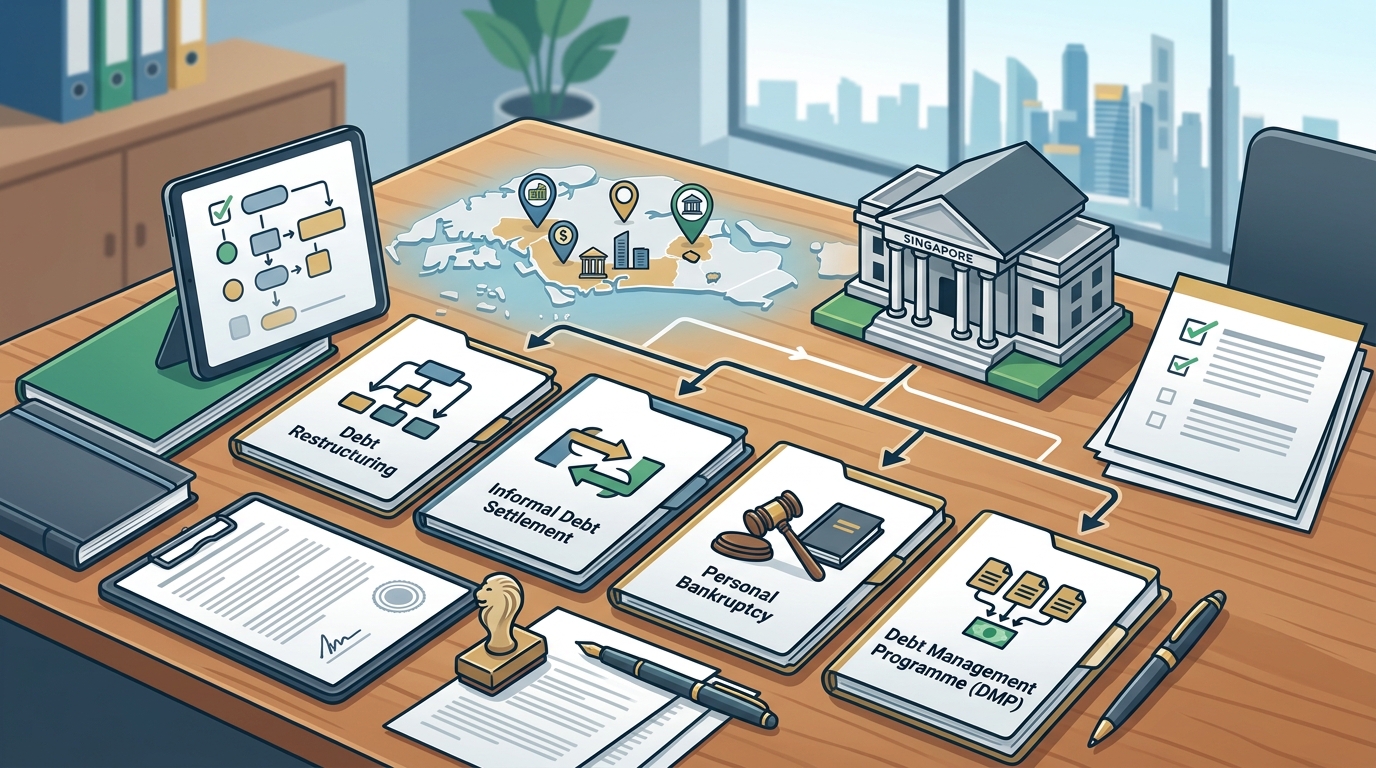
Bankruptcy should be viewed as a last resort. Singapore offers several structured alternatives that can resolve debt problems without the severe consequences of a formal bankruptcy order.
1. Debt Consolidation Plan (DCP)
The DCP, offered by participating banks, is designed for individuals whose total unsecured debts exceed 12 times their monthly income. It consolidates multiple unsecured debts into a single monthly repayment at a reduced interest rate, typically over an extended period. This is usually the first option for those still servicing their debts but struggling with multiple obligations.
2. Debt Repayment Scheme (DRS)
The DRS is the most significant statutory alternative to bankruptcy. Administered by the Official Assignee (OA) from the Ministry of Law's Insolvency Office, it allows eligible debtors to enter a structured debt repayment plan (DRP) instead of being declared bankrupt.
Key eligibility criteria for the DRS include:
- Total debts must not exceed S$150,000
- The debtor must be employed and earning a regular income at the time of assessment
- The debtor must not be an undischarged bankrupt or have been on DRS within the past five years
- The debtor must not be a sole proprietor or partner in any business
Under the DRS, debtors are expected to comply with their repayment plan — including payment of monthly instalments and statutory fees — over a period of not more than five years. Critically, unlike bankruptcy, the debtor retains possession of their assets. The OA monitors payments and compliance rather than taking control of the debtor's estate.
A major advantage is protection from legal action: once formal DRS proceedings are in place, unsecured creditors cannot take legal action against the debtor without the court's permission.
Upon successful completion, the OA issues a Certificate of Completion and the debtor is released from all debts disclosed under the DRS — without ever having been declared bankrupt.
3. Voluntary Arrangement (VA)
A voluntary arrangement is a court-approved agreement between a debtor and creditors. It requires approval from a majority of creditors (by number and by 75% in value of debts) and then becomes binding on all creditors subject to it. This mechanism allows for flexible debt restructuring, including reduced repayment amounts, extended timelines, or partial debt forgiveness.
The IRDA enables individual debtors to pre-emptively propose a voluntary arrangement to avoid bankruptcy proceedings entirely. A licensed insolvency practitioner serves as nominee to facilitate the process.
4. Informal Negotiation with Creditors
Before any formal proceedings, debtors can approach creditors directly — or through a lawyer — to negotiate revised repayment terms. Many creditors, particularly financial institutions, prefer negotiated settlements over the uncertainty of bankruptcy proceedings, where they might recover even less.
How Bankruptcy Works in Singapore: Step-by-Step
If the alternatives above are not viable, bankruptcy may be the remaining option. Here is what the process involves:
Step 1: Filing the Bankruptcy Application
A bankruptcy application is filed in the High Court, either by the debtor (voluntary bankruptcy) or by a creditor. The debtor must owe at least S$15,000 in debts that are immediately payable. Where a creditor files, they must first have served a statutory demand — a formal notice requiring payment within 21 days. Failure to pay or set aside the demand within 14 days creates a presumption of inability to pay.
Step 2: Court Hearing and Possible DRS Referral
At the hearing, the High Court may refer the case to the OA for DRS assessment if the debts do not exceed S$150,000. The court may adjourn the matter for up to six months for this assessment. Only if the debtor is found unsuitable for the DRS — or debts exceed the threshold — will proceedings continue toward a bankruptcy order.
Step 3: Appointment of a Private Trustee in Bankruptcy (PTIB)
Since 1 November 2023, all debtors and creditors filing bankruptcy applications must nominate a licensed insolvency practitioner to serve as Private Trustee in Bankruptcy (PTIB). The OA only takes on the role where there is a public interest reason. The PTIB manages the bankrupt's estate, including the realisation of assets and distribution to creditors.
Step 4: Statement of Affairs
After a bankruptcy order is made, the bankrupt must submit a detailed Statement of Affairs listing all assets, liabilities, and recent financial activities. Full and honest disclosure is mandatory.
Step 5: Life During Bankruptcy
The consequences of bankruptcy are significant:
- Asset surrender: Non-essential assets are handed over to creditors
- Income contribution: A portion of ongoing income (the “target contribution”) must be paid to creditors
- Travel restrictions: Bankrupts generally cannot leave Singapore without permission
- Credit impact: Credit rating is severely damaged for years
- Professional restrictions: Certain professions and directorships are barred during bankruptcy
- Social stigma: Bankruptcy is publicly recorded, affecting career and personal relationships
Step 6: Discharge from Bankruptcy
Bankruptcy typically lasts between three and seven years for first-time bankrupts. Those who fully pay their target contribution and have no prior bankruptcies may be discharged in three to five years. Failure to meet targets or previous bankruptcies can extend this to seven years or longer.
Discharge can come via the OA (by certificate) or the court. The court considers factors such as the amount of debt, the cause of bankruptcy, and the bankrupt's conduct. Certain “special facts” — such as extravagant living that contributed to bankruptcy or prior bankruptcy offences — may prevent discharge.
Recent Developments: Proposed DRS Reforms (2025)
In June 2025, the Ministry of Law launched a public consultation on proposed amendments to the DRS framework. Key proposals include:
- New criminal offence: Criminalising consultancy firms that solicit or canvass individuals to file bankruptcy applications with the intent of exploiting the DRS for debt “haircuts”
- New unsuitability grounds: Debtors who incur debts without reasonable expectation of repayment within 12 months before filing may be found unsuitable for DRS
- Creditor filing deadline: A proposed four-week deadline for creditors to file proofs of debt after notice from the OA
These reforms target a rising trend of debtors borrowing irresponsibly — sometimes encouraged by unlicensed firms — specifically to enter the DRS and avoid full repayment. If enacted, the changes will significantly tighten entry criteria.
Choosing the Right Path: A Decision Framework
| Factor | DCP | DRS | Voluntary Arrangement | Bankruptcy |
|---|---|---|---|---|
| Debt threshold | No statutory cap | Up to S$150,000 | No cap | Minimum S$15,000 |
| Asset retention | Yes | Yes | Depends on terms | No (non-essential assets seized) |
| Travel restrictions | None | None | None | Yes |
| Public record | No | No | No | Yes |
| Duration | Up to 10 years | Up to 5 years | As agreed | 3–7+ years |
| Creditor protection from action | Limited | Yes (unsecured creditors) | Yes (once approved) | Yes (automatic stay) |
Practical Tips for Navigating Debt Restructuring
- Act early. The sooner you address debt problems, the more options remain available. Waiting until a statutory demand arrives drastically limits your choices.
- Get professional advice. Insolvency law is complex. A Singapore-qualified lawyer experienced in bankruptcy and restructuring matters can evaluate your specific situation and recommend the most suitable pathway.
- Be completely honest. Whether you are on the DRS or in bankruptcy, failure to disclose assets or provide accurate financial information can result in criminal penalties, certificate of failure, or denied discharge.
- Understand your obligations. Each option — DRS, VA, or bankruptcy — comes with strict compliance requirements. Missing a single payment or reporting obligation can derail your case.
- Consider the long-term impact. Bankruptcy stays on your credit record for years after discharge and restricts professional opportunities. The DRS and voluntary arrangements, by contrast, preserve your reputation and financial flexibility.
Key Takeaways
- Singapore's IRDA provides a structured framework covering both debt restructuring alternatives and formal bankruptcy proceedings.
- The Debt Repayment Scheme (DRS) is the primary statutory alternative to bankruptcy for debts up to S$150,000, allowing repayment over up to five years while retaining assets.
- Voluntary arrangements offer additional flexibility for debtors of any debt quantum, provided creditors agree.
- Bankruptcy requires a minimum debt of S$15,000 and carries significant personal, professional, and financial consequences lasting years.
- Since November 2023, a Private Trustee in Bankruptcy (PTIB) is the default administrator for all bankruptcy cases in Singapore.
- Proposed 2025 reforms aim to tighten DRS eligibility and criminalise exploitative consultancy practices.
- Early legal advice is critical — the best outcomes arise when debtors explore restructuring options before creditor-initiated proceedings begin.
Frequently Asked Questions
What is the minimum debt required to file for bankruptcy in Singapore?
Under the IRDA, you must owe at least S$15,000 in debts that are immediately payable and enforceable in Singapore before a bankruptcy application can be filed in the High Court.
What is the Debt Repayment Scheme (DRS) in Singapore?
The DRS is a pre-bankruptcy programme administered by the Official Assignee. It allows eligible debtors to repay their debts through a structured plan over up to five years, avoiding the formal bankruptcy process. Total debts must not exceed S$150,000, and debtors must be gainfully employed, among other criteria.
How long does bankruptcy last in Singapore?
For first-time bankrupts, the period typically ranges from three to seven years. Those who meet their target contribution and cooperate fully may be discharged in three to five years. Repeat bankrupts or non-compliant individuals may remain bankrupt for seven years or longer.
Can I avoid bankruptcy through a voluntary arrangement?
Yes. A voluntary arrangement is a court-approved agreement between a debtor and creditors involving restructured repayment terms. It becomes binding once approved by a majority of creditors representing at least 75% of the debt value. It is one of several recognised alternatives to bankruptcy under Singapore law.
What restrictions apply during bankruptcy in Singapore?
Bankrupts must surrender non-essential assets, make income contributions to creditors, observe travel restrictions, and face limitations on acting as company directors or holding certain professional positions. Their credit rating will also be severely affected for an extended period after discharge.
Who manages a bankrupt's estate in Singapore?
Since 1 November 2023, a Private Trustee in Bankruptcy (PTIB) — a licensed insolvency practitioner — is the default administrator for all bankruptcy cases. The Official Assignee only administers cases involving a public interest element.
How I.R.B Law LLP Can Help
Navigating debt restructuring and bankruptcy proceedings in Singapore requires careful analysis of your financial position, understanding of the IRDA framework, and strategic decision-making. At I.R.B Law LLP, our experienced insolvency and dispute resolution lawyers assist clients across the full spectrum — from exploring DRS eligibility and negotiating voluntary arrangements to representing debtors and creditors in bankruptcy proceedings. Contact us for a confidential consultation to discuss your options.