

Financial distress in Singapore is a growing concern, with recent data indicating that personal insolvency cases have surged significantly in the post-pandemic era. According to the Official Assignee's office, the number of individual bankruptcy cases has seen a sharp increase, reflecting the economic pressures faced by many residents. Navigating this landscape requires a clear understanding of your legal options, specifically the choice between Debt Restructuring and formal Bankruptcy. This guide outlines the critical differences, procedural requirements, and strategic implications of each path to help you make an informed decision. (Cross Border Money Transfers)
Understanding the Core Options
When you are unable to meet your debt obligations, Singapore law provides specific mechanisms to address the situation. The primary distinction lies in whether you can reach an agreement with your creditors to restructure your debts or if you must seek court protection through insolvency proceedings. Debt Restructuring is a voluntary process where you negotiate with creditors to pay back debts over a longer period. In contrast, Bankruptcy is a legal status imposed by the court when debts cannot be managed through private arrangements.
Choosing the wrong path can have severe long-term consequences for your credit rating, employment prospects, and personal freedom. For instance, a bankruptcy order restricts your ability to travel, hold directorships, and obtain credit. Therefore, it is essential to understand the eligibility criteria and legal implications of each route before proceeding.
The Debt Restructuring Agreement (DRA) Path
The Debt Restructuring Agreement (DRA) is a private arrangement between you and your unsecured creditors. It allows you to pay off your debts in installments over a period of up to five years. This option is ideal for individuals who have a steady income but are temporarily cash-strapped.
To initiate a DRA, you must submit a proposal to your creditors outlining how you plan to repay the debts. The proposal must be accepted by creditors representing at least 50% in value of the total debt. Once approved, the agreement is binding on all unsecured creditors, including those who voted against it. This provides a layer of protection against aggressive debt collection tactics.
However, the DRA process requires strict adherence to the repayment schedule. Failure to comply can result in the agreement being terminated, potentially leading to bankruptcy proceedings. It is crucial to have legal counsel review your proposal to ensure it is realistic and acceptable to creditors.
The Individual Insolvency Programme (IIP)
Introduced to provide a more structured alternative to bankruptcy, the Individual Insolvency Programme (IIP) is a formal insolvency regime for individuals with debts between $1.5 million and $72 million. This program allows you to propose a scheme of arrangement to your creditors, similar to a DRA but with greater legal framework support.
The IIP is particularly useful for high-net-worth individuals or business owners who face complex debt structures. It offers the benefit of avoiding the stigma of bankruptcy while still providing a mechanism to restructure debts. The program requires court approval and involves a detailed assessment of your financial affairs.
One of the key advantages of the IIP is the potential for a discharge from insolvency obligations upon successful completion of the scheme. This allows you to regain financial stability without the long-term restrictions associated with bankruptcy. However, the process is complex and requires significant legal and financial expertise to navigate effectively.
When Formal Bankruptcy Becomes Necessary
If you are unable to reach a DRA or qualify for the IIP, formal bankruptcy may be the only remaining option. Bankruptcy in Singapore is governed by the Insolvency, Restructuring and Dissolution Act 2018 (IRDA). It is typically initiated by a creditor filing a bankruptcy petition against you, or by you filing a voluntary bankruptcy application.
For a creditor to file a petition, you must owe them at least $15,000 and have committed an act of insolvency, such as failing to comply with a statutory demand. The statutory demand is a formal written demand for payment, which must be paid, secured, or compounded within 21 days. Failure to do so allows the creditor to file for your bankruptcy.
Once a bankruptcy order is made, your assets are vested in the Official Assignee (OA), who manages the distribution of your estate to creditors. You are subject to various restrictions, including limitations on travel and business activities. The duration of bankruptcy depends on your cooperation and financial circumstances, typically lasting three years for those who cooperate fully.
It is important to note that bankruptcy does not automatically discharge all debts. Certain obligations, such as student loans and court fines, may survive the bankruptcy process. Additionally, the impact on your credit rating can last for several years, affecting your ability to secure future loans or mortgages.
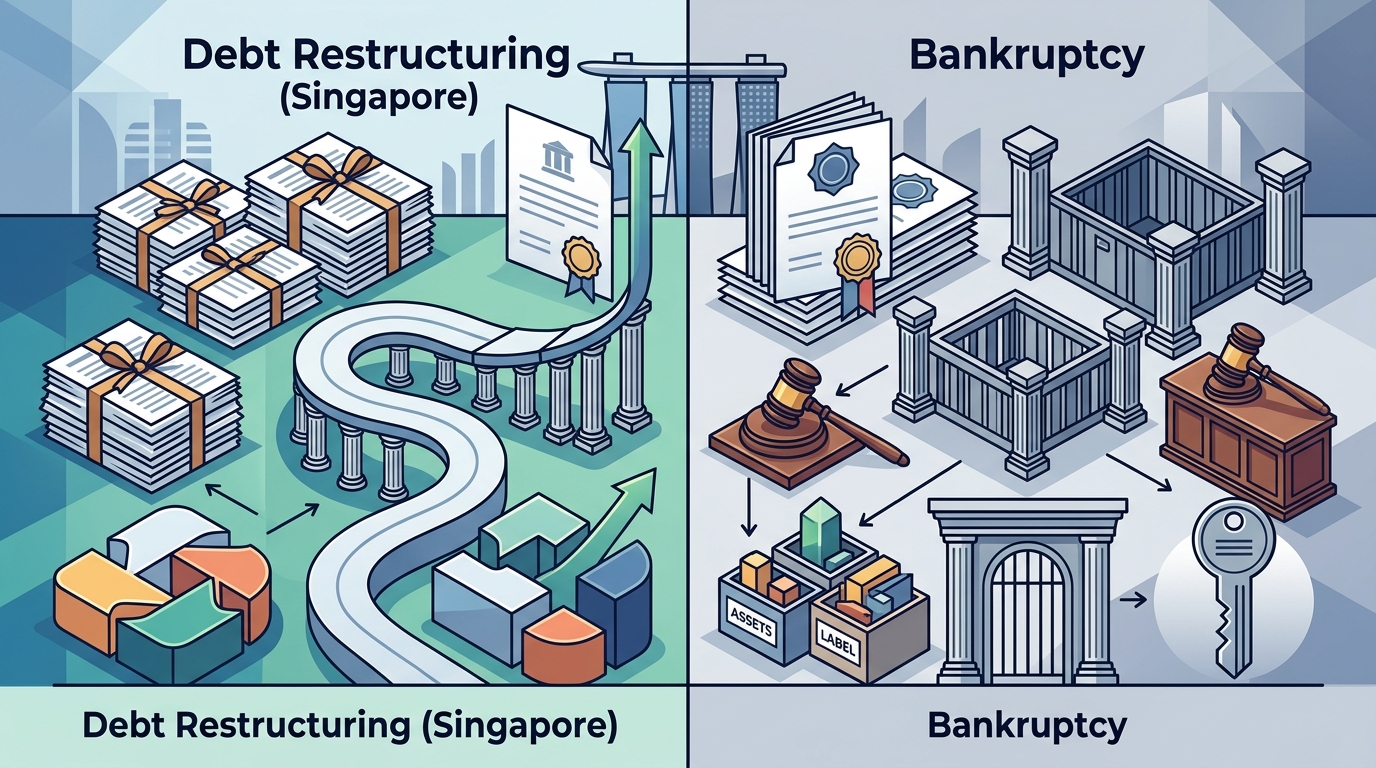
Comparing DRA, IIP, and Bankruptcy
Understanding the differences between these options is critical for making the right choice. The following table summarizes the key distinctions:
| Feature | Debt Restructuring Agreement (DRA) | Individual Insolvency Programme (IIP) | Formal Bankruptcy |
|---|---|---|---|
| Debt Limit | Up to $1.5 million | $1.5 million to $72 million | No upper limit |
| Initiation | Voluntary (by debtor) | Voluntary (by debtor) | Creditor or Voluntary |
| Creditors' Consent | Required (50% in value) | Required (majority in value) | Not required for order |
| Asset Control | Debtor retains control | Debtor retains control | Transferred to Official Assignee |
| Duration | Up to 5 years | As per scheme | Typically 3 years |
| Stigma | Low | Moderate | High |
Key Takeaways
- DRA Eligibility: The Debt Restructuring Agreement is available for unsecured debts up to $1.5 million, requiring creditor consent for at least 50% of the debt value.
- IIP Scope: The Individual Insolvency Programme is designed for individuals with debts between $1.5 million and $72 million, offering a structured alternative to bankruptcy.
- Bankruptcy Threshold: A creditor can file for your bankruptcy if you owe at least $15,000 and fail to comply with a statutory demand within 21 days.
- Asset Vesting: In formal bankruptcy, your assets are vested in the Official Assignee, who manages the distribution to creditors.
- Restrictions: Bankruptcy imposes significant restrictions on travel, employment, and credit access, which can last for several years.
- Legal Counsel: Engaging a qualified lawyer is crucial for navigating the complexities of debt restructuring and insolvency proceedings.
- IRDA 2018: The Insolvency, Restructuring and Dissolution Act 2018 governs these processes, providing a modern framework for handling personal insolvency.
Frequently Asked Questions
What is the difference between debt restructuring and bankruptcy?
Debt restructuring is a voluntary agreement with creditors to repay debts over time, whereas bankruptcy is a legal status imposed by the court that involves the management of your assets by an Official Assignee.
Can I file for bankruptcy if I owe less than $15,000?
Yes, you can file for voluntary bankruptcy regardless of the debt amount. However, a creditor can only file a bankruptcy petition against you if you owe at least $15,000.
How long does bankruptcy last in Singapore?
Bankruptcy typically lasts for three years from the date of the bankruptcy order, provided you cooperate with the Official Assignee and meet all requirements.
What is a statutory demand?
A statutory demand is a formal written demand for payment of a debt. If you fail to pay, secure, or compound the debt within 21 days, the creditor can file for your bankruptcy.
Can I keep my house if I am bankrupt?
Your house is considered an asset and may be sold by the Official Assignee to pay off creditors. However, there may be exemptions or arrangements depending on your specific circumstances.
What is the Individual Insolvency Programme (IIP)?
The IIP is a formal insolvency regime for individuals with debts between $1.5 million and $72 million, allowing them to propose a scheme of arrangement to creditors.
Do I need a lawyer for debt restructuring?
While not strictly mandatory, having a lawyer is highly recommended to ensure your proposal is realistic, legally sound, and acceptable to creditors.
Contact IRB Law LLP
Navigating debt restructuring and bankruptcy requires expert legal guidance. IRB Law LLP offers comprehensive legal services in this area, helping individuals and businesses make informed decisions. Our team of experienced lawyers is dedicated to providing practical solutions tailored to your unique financial situation. We understand the stress and complexity involved in these matters and are committed to supporting you through every step of the process.
If you are facing financial difficulties, do not wait until it is too late. Contact us today to schedule a consultation. We can help you explore your options, including debt restructuring and bankruptcy advice. Our office is open from Monday to Friday, 9:30 am to 6 pm, and by appointment on weekends. Reach out to us at hello@irblaw.com.sg or call +65 6298 2537 to discuss your case.