

Understanding the legal pathways to end a marriage in Singapore requires distinguishing between two primary mechanisms: divorce and annulment. While both result in the termination of a marital relationship, their legal foundations, eligibility criteria, and financial implications differ significantly. In Singapore, divorce is the standard procedure for ending a valid marriage, whereas annulment declares a marriage void or voidable from its inception. According to recent legal data, the vast majority of marital dissolutions in Singapore are processed through divorce, with annulments reserved for specific, narrow circumstances involving fundamental defects in the marriage contract. (Cross Border Money Transfers)
Grounds for Dissolution
The foundation of any marital dissolution in Singapore rests on specific legal grounds. For divorce, the sole ground is the irretrievable breakdown of the marriage. This is established by proving one of four facts: adultery, unreasonable behavior, desertion for at least two years, or separation for three or four years depending on consent. This framework ensures that the marriage has fundamentally failed beyond repair. (Top Law Firm in)
Annulment, however, operates on a different premise. It does not address the breakdown of a functional marriage but rather the validity of the marriage itself. Annulment is granted when the marriage is deemed void or voidable due to specific defects present at the time of the ceremony. These defects might include lack of consent, prohibited degrees of relationship, or failure to comply with statutory requirements for marriage solemnization. (Join Us IRB Law)
Legal Status of the Marriage
The distinction in legal status is critical for future rights and obligations. Divorce terminates a valid marriage from the date of the absolute order onwards. The marriage is considered to have existed and been valid until that point. This has significant implications for inheritance rights and the legitimacy of children born during the marriage. (Meet Our Lawyers and)
In contrast, an annulment declares the marriage null and void ab initio, meaning from the beginning. Legally, the marriage is treated as if it never existed. This distinction can affect the status of children, although Singapore law generally protects the legitimacy of children born during a voidable marriage that is later annulled. It also impacts the ability to remarry without potential legal complications regarding bigamy.
Financial and Property Implications
Financial outcomes differ markedly between the two processes. In a divorce, the court has broad powers to divide matrimonial assets fairly. The Women’s Charter provides guidelines for dividing assets acquired during the marriage, considering factors such as the extent of contributions made by each party and the needs of any children.
Annulment proceedings do not automatically trigger the same matrimonial asset division framework. Since the marriage is considered never to have existed, the concept of "matrimonial assets" is legally complex. However, courts can still make orders for the division of property based on general principles of equity and trust law. This often requires more intricate legal argumentation to establish ownership and entitlement to assets acquired during the cohabitation period.
Eligibility Criteria
Eligibility for divorce requires that at least one party is domiciled in Singapore or has been habitually resident in Singapore for at least three years immediately preceding the filing. The marriage must also be recognized under Singapore law. This ensures that Singapore courts have jurisdiction over the dissolution.
Annulment eligibility is stricter regarding the nature of the defect. For a void marriage, such as one where the parties are within prohibited degrees of relationship, there are no time limits for seeking annulment. For a voidable marriage, such as one where consent was obtained by force, the application must typically be made within a reasonable time after the discovery of the defect. Delay can be interpreted as affirmation of the marriage, barring the annulment.
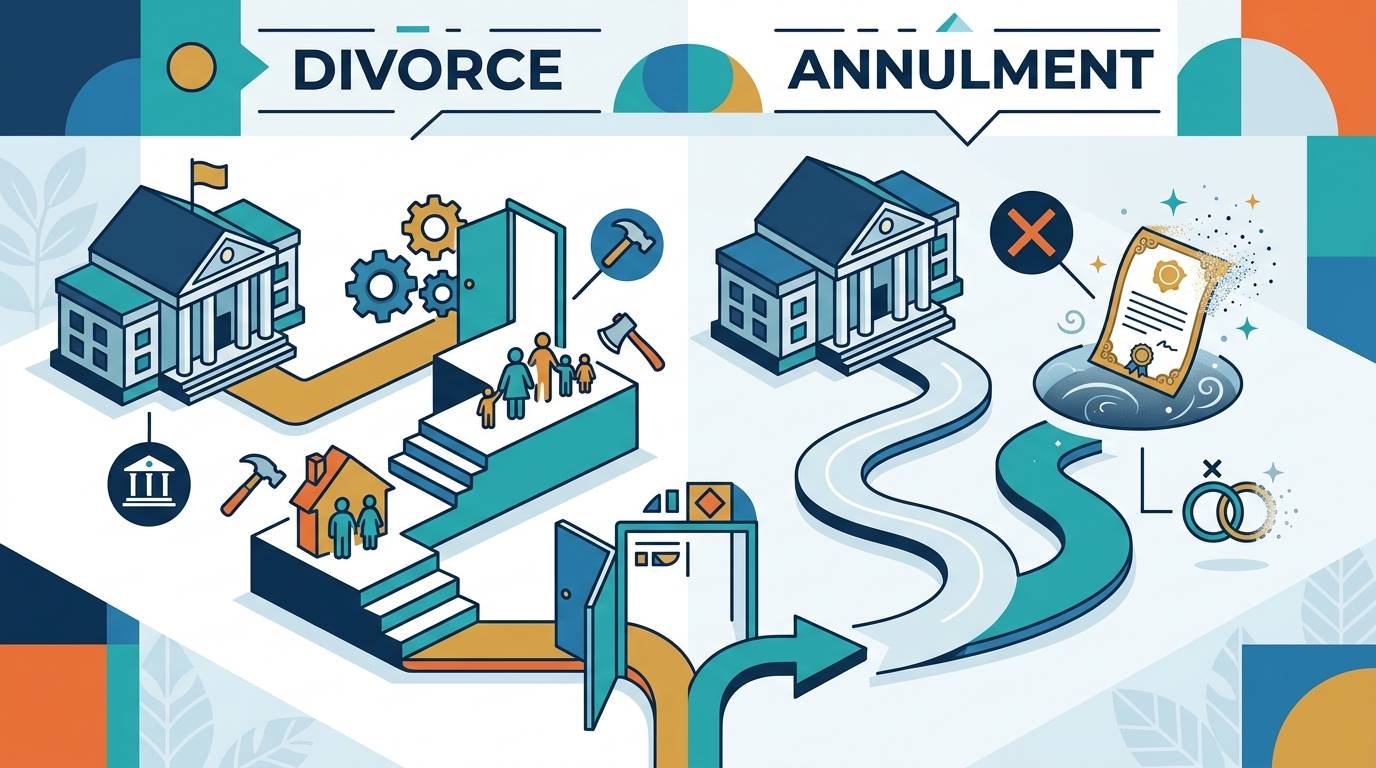
Comparison Summary
| Feature | Divorce | Annulment |
|---|---|---|
| Legal Effect | Ends valid marriage from date of order | Declares marriage void from inception |
| Primary Grounds | Irretrievable breakdown (4 facts) | Defects in marriage validity |
| Asset Division | Matrimonial assets divided fairly | Equitable distribution based on ownership |
| Time Limits | No strict time limit post-separation | Must be reasonable time for voidable marriages |
| Child Status | Children remain legitimate | Children generally protected by law |
Key Takeaways
- Divorce is the standard route for ending a valid marriage due to irretrievable breakdown.
- Annulment is reserved for marriages with fundamental legal defects from the start.
- Divorce involves a structured process for dividing matrimonial assets under the Women’s Charter.
- Annulment treats the marriage as never having existed, complicating asset claims.
- IRB Law LLP provides specialized counsel for both family law and dispute resolution matters.
- Legal advice is crucial to determine the correct pathway based on your specific circumstances.
- Time limits for annulment applications can be strict, especially for voidable marriages.
Frequently Asked Questions
What is the main difference between divorce and annulment?
Divorce ends a valid marriage, while annulment declares the marriage void or voidable from the beginning, as if it never existed.
Can I get an annulment if I was coerced into marriage?
Yes, coercion is a ground for voidable marriage. You must apply for annulment within a reasonable time after the coercion ceases or is discovered.
How are assets divided in an annulment?
Unlike divorce, there is no automatic matrimonial asset division. Courts use equitable principles to distribute property based on ownership and contribution.
Is legal representation required for annulment?
While not strictly mandatory, annulment cases are legally complex. Professional guidance ensures your rights are protected and procedures are followed correctly.
What happens to children in an annulment case?
Singapore law generally protects the legitimacy of children born during a voidable marriage, ensuring their rights to maintenance and inheritance are preserved.
How long does an annulment process take?
The duration varies based on complexity and court schedules. It can take several months to over a year, depending on whether the case is contested.
Can I remarry after an annulment?
Yes, once the annulment order is absolute, you are free to remarry as the marriage is legally considered never to have existed.
Contact IRB Law LLP
Navigating the complexities of marital dissolution requires precise legal strategy. Whether you are considering divorce or exploring the grounds for annulment, expert guidance is essential. IRB Law LLP offers dedicated family law services tailored to your unique situation. Our team is committed to providing clear, actionable advice to help you move forward with confidence.
Contact us today to schedule a consultation. Visit our Contact Us page or call +65 6298 2537 to discuss your case with our experienced lawyers.