

Recent court filings indicate that approximately thirty percent of all marital dissolution cases in Singapore proceed through contested litigation. This statistic reflects a growing complexity in modern family law. Navigating these proceedings requires precise procedural knowledge. Our firm provides structured guidance for both pathways. You can explore our comprehensive family law services here to understand how we handle complex marital disputes. The Singapore legal framework demands strict adherence to the Women’s Charter. Understanding the exact procedural differences will save you time and legal expenses. (Contact Us I R)
Understanding the Core Legal Distinction
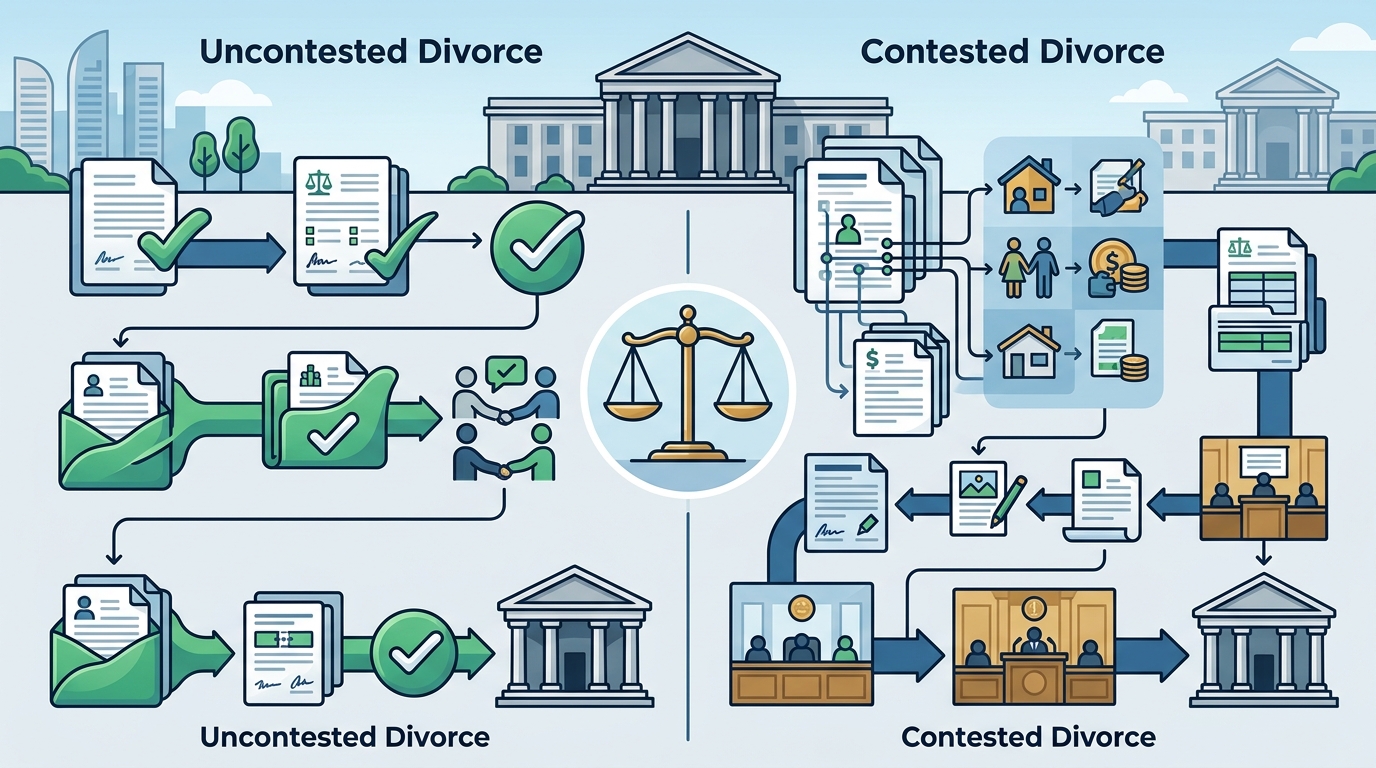
Divorce proceedings in Singapore fall into two distinct categories. An uncontested divorce is a legal proceeding where both spouses mutually agree on all terms without requiring judicial intervention. A contested divorce is a litigation pathway where spouses cannot reach a mutual agreement on critical financial or custody issues. The court must intervene to resolve these disputes. You can review our dedicated divorce lawyers page to see how our team manages high-stakes marital litigation. The procedural timeline differs significantly between these two tracks. Uncontested cases typically resolve within six months. Contested matters often extend beyond eighteen months. Legal costs scale directly with the level of disagreement. Our team maintains a dedicated counselling support page to assist clients through emotional transitions. You should consult a qualified attorney before selecting your litigation strategy. (Join Us IRB Law)
Uncontested Pathway
Both parties must sign a joint statement confirming their agreement. This document eliminates the need for lengthy court hearings. The court reviews the paperwork for procedural compliance. Judges grant the decree nisi without requiring physical attendance. This process prioritizes efficiency and reduces financial strain. Families benefit from faster resolution and lower legal fees. The court expects full financial disclosure from both parties. Hidden assets will trigger immediate judicial sanctions. (Meet Our Lawyers and)
Contested Pathway
Disagreements over maintenance, custody, or property division trigger formal litigation. Each party files detailed affidavits outlining their positions. The court schedules multiple case conferences to manage the docket. Judges actively monitor progress and enforce strict deadlines. Litigation costs accumulate rapidly as discovery phases expand. Clients often require expert valuations for complex business assets. Our firm handles cross-border money transfer disputes and banking fraud cases that frequently complicate marital settlements. You can read our latest insights on financial fraud here to understand how external factors impact divorce proceedings. The court prioritizes the welfare of minor children above all other considerations.
Filing the Initial Writ of Divorce
The legal process begins with the preparation of a Writ of Divorce. This document formally notifies the court and the opposing party. You must attach a certified copy of the marriage certificate. The plaintiff must also file a Statement of Facts. This filing establishes the five-year marriage requirement or proves unreasonable behavior. The court assigns a case number upon submission. You must serve the documents to the defendant through a process server. Proof of service must be filed within fourteen days. Our legal team ensures every document meets the Supreme Court registry standards. You can contact our office directly to schedule a case evaluation. The registry rejects incomplete filings immediately. Missing signatures or outdated certificates cause unnecessary delays. Proper preparation prevents procedural setbacks.
Documentation Requirements
Both spouses must submit comprehensive financial statements. These forms detail all assets, liabilities, and income streams. The court requires bank statements for the past twenty-four months. Property valuations must come from certified professionals. The registry verifies all supporting documents before proceeding. Incomplete submissions result in automatic referrals to case management conferences. Our attorneys review every financial disclosure for accuracy. We also assist clients with Syariah divorce procedures when applicable. The court expects complete transparency throughout the filing stage. Any discrepancy triggers immediate judicial scrutiny.
Court Directions and Case Management
Case management is a judicial oversight process that establishes strict timelines and enforces document exchange deadlines. Judges use these sessions to establish clear schedules. Each party must attend these hearings in person. The court sets strict deadlines for document exchange. Judges actively encourage settlement discussions before trial. Our firm utilizes structured negotiation frameworks to resolve disputes efficiently. The court maintains a dedicated registry for family law matters. You can access our news updates here to stay informed about recent procedural changes. Judges prioritize minimizing court appearances for both parties. The registry tracks compliance with every court order. Failure to meet deadlines results in cost penalties. Active judicial oversight ensures case progression remains steady. Parties must cooperate fully to avoid procedural sanctions.
Financial and Custody Negotiations
Asset division and child custody form the core of most marital disputes. The court applies the Women’s Charter guidelines to determine fair outcomes. Uncontested cases proceed through mediation sessions. Contested matters require formal expert testimony. The court evaluates earning capacity, health conditions, and direct contributions. Judges prioritize the best interests of minor children. Care and control arrangements determine primary residence. Access schedules dictate visitation rights. Our legal team drafts precise custody proposals that withstand judicial scrutiny. You can explore our estate planning services here to understand how divorce impacts long-term wealth preservation. The court expects detailed parenting plans. Financial disclosures undergo rigorous cross-examination. Hidden accounts or undervalued properties trigger immediate investigations. Judges award maintenance based on proven financial need. The process demands meticulous preparation and strategic negotiation.
The Final Hearing and Judgment Process
The final hearing represents the concluding phase of contested litigation. Both parties present oral arguments before a judge. Lawyers submit comprehensive bundles of evidence and legal submissions. The court reviews all arguments before issuing a judgment. Uncontested cases proceed directly to the decree nisi stage. Judges review the paperwork for legal sufficiency. The court grants the decree nisi after confirming procedural compliance. Parties must wait six weeks before applying for the decree absolute. This waiting period allows for any final objections. Our attorneys prepare clients for courtroom testimony. The court expects professional conduct throughout the hearing. Judges dismiss frivolous arguments immediately. Successful litigation requires precise legal drafting and strategic advocacy. You can book a consultation with our team to discuss your specific case. The final judgment carries binding legal force. Both parties must comply with all court orders immediately.
Procedural Comparison Matrix
| Procedural Stage | Uncontested Divorce | Contested Divorce |
|---|---|---|
| Initial Filing | Joint statement required. Standard Writ submission. | Plaintiff files Writ. Detailed Statement of Facts required. |
| Timeline | Six to eight months average processing time. | Eighteen to thirty-six months average processing time. |
| Court Appearances | Minimal. Usually limited to registry submission. | Multiple case conferences and final hearing required. |
| Legal Costs | Fixed fee structures available. Lower overall expenditure. | Hourly billing applies. High discovery and expert fees. |
| Child Arrangements | Pre-agreed parenting plan submitted with filing. | Expert psychological assessments often required. |
Key Takeaways
- Uncontested divorces typically resolve within six months when both parties cooperate fully.
- Contested litigation extends beyond eighteen months due to mandatory case conferences.
- The Singapore Supreme Court registry rejects incomplete financial disclosures immediately.
- Both pathways require strict adherence to the Women’s Charter procedural rules.
- Legal fees scale directly with the number of disputed assets and custody claims.
- Our firm maintains a dedicated case management system for high-volume family law matters.
- Financial transparency remains the primary factor in judicial decision making.
Frequently Asked Questions
What defines an uncontested divorce in Singapore?
An uncontested divorce is a legal proceeding where both spouses mutually agree on all terms, including asset division and child custody, without requiring judicial intervention.
How long does a contested divorce take in Singapore?
Contested divorces typically require eighteen to thirty-six months to reach a final judgment due to mandatory case conferences and discovery phases.
Can I modify a custody arrangement after the divorce is finalized?
Yes, either party may apply to vary custody orders if circumstances change significantly. The court prioritizes the child’s best interests during review.
What documents are required to file for divorce?
Plaintiffs must submit a certified marriage certificate, a Writ of Divorce, and a Statement of Facts proving the marriage breakdown.
How does the court handle hidden assets during divorce?
The court orders full financial disclosure and may appoint forensic accountants to trace concealed funds. Sanctions apply for non-compliance.
Is legal representation mandatory for divorce proceedings?
Legal representation is not strictly mandatory but highly recommended. Complex asset structures require professional legal drafting.
Secure Your Legal Future Today
Divorce proceedings demand precise documentation and strategic advocacy. Our experienced team handles complex marital disputes with discretion and efficiency. You can schedule a confidential consultation by visiting our contact page. We provide clear pricing models and structured service delivery for every case. Contact IRB Law LLP today to begin your legal journey. Our office operates Monday through Friday with weekend appointments available. Call +65 6298 2537 or email hello@irblaw.com.sg for immediate assistance. We stand with you through every procedural milestone.