

Divorce in Singapore is a complex legal process governed by the Women's Charter. The path you take depends entirely on whether your marriage has broken down irretrievably and if you can reach an agreement with your spouse. According to recent legal trends, the distinction between contested and uncontested divorce determines not just the emotional toll, but the financial and temporal cost of ending a marriage. Understanding these differences is critical for making informed decisions during one of life's most challenging transitions.
The Uncontested Divorce Pathway
An uncontested divorce, often referred to as a simplified divorce, is the most efficient route for couples who have reached a mutual agreement on all major issues. This pathway is available when both parties agree that the marriage has irretrievably broken down and, crucially, there are no children of the marriage below the age of 18.
If you have children under 18, the court requires proof that you have made satisfactory arrangements for their care, maintenance, and education. In such cases, the divorce is not technically "uncontested" in the simplest sense, but it can still proceed without full litigation if the arrangements are accepted by the court. The process involves filing a Statement of Claim, followed by a Certificate of Fitness for Summary Judgment. If the court is satisfied that the marriage has indeed broken down irretrievably, a Certificate of Fitness is issued, allowing the case to proceed to the trial stage for the final Divorce Order.
This route is significantly faster and less expensive. It minimizes adversarial conflict, which is particularly beneficial when preserving a cooperative co-parenting relationship is a priority. For more details on the specific legal steps for contested versus uncontested divorce, you can review our comprehensive guide on divorce procedures.
The Contested Divorce Process
A contested divorce occurs when one party disagrees with the divorce itself or cannot reach an agreement on ancillary matters such as child custody, maintenance, or asset division. This path is legally intricate and emotionally draining. It involves a series of court hearings where each party presents their case to a judge.
The process begins with the filing of a Writ of Divorce and a Statement of Claim. The respondent must then file a Defence, outlining their objections. If the dispute involves financial matters, a separate Form 81 application may be filed to address the division of matrimonial assets. The court may order mediation or case management conferences to try and resolve disputes before a full trial.
Contested divorces can drag on for months or even years, depending on the complexity of the assets and the level of conflict. Legal fees accumulate rapidly as each side hires counsel to advocate for their interests. IRB Law LLP provides robust divorce lawyer services to navigate these turbulent waters, ensuring your rights are protected throughout the litigation.
Key Differences: Cost and Timeline
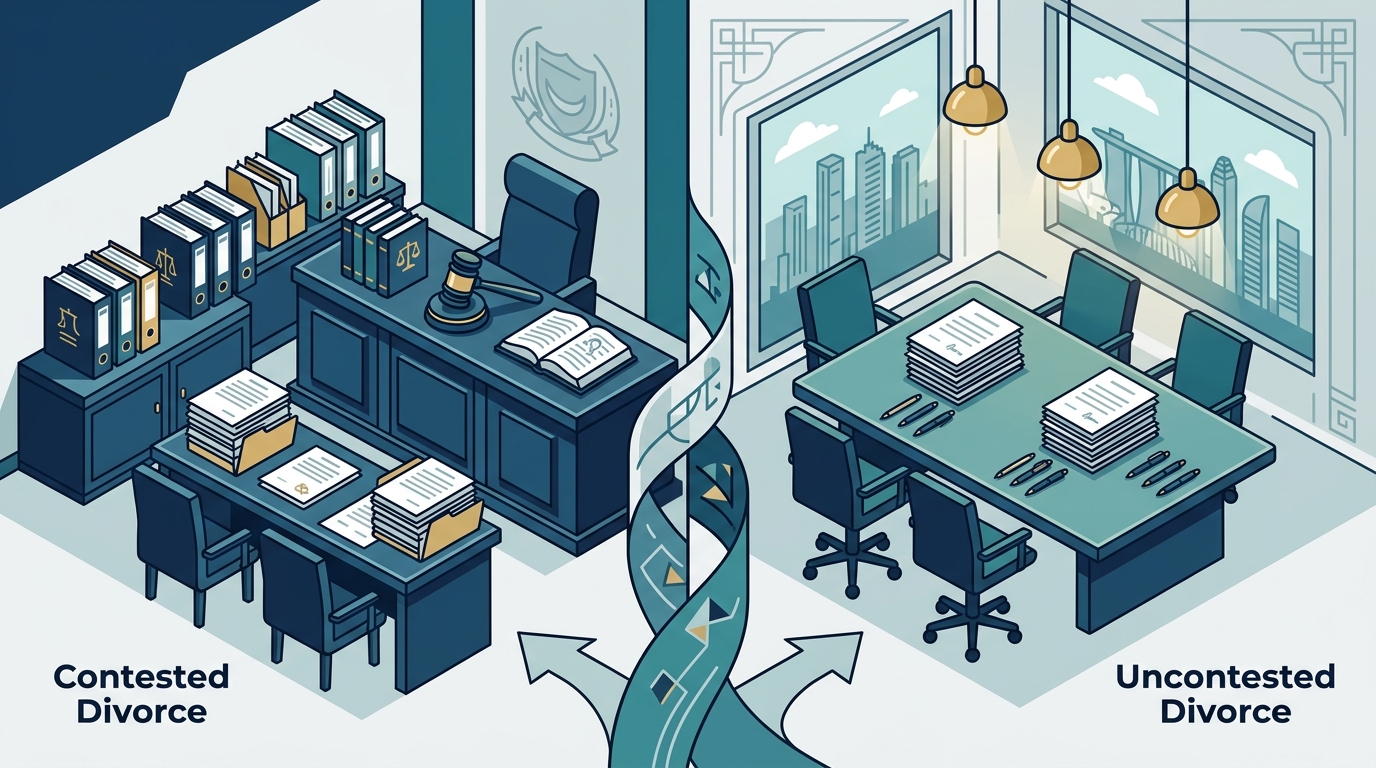
The choice between contested and uncontested divorce has profound implications for your wallet and your timeline. The table below summarizes the core distinctions.
| Factor | Uncontested Divorce | Contested Divorce |
|---|---|---|
| Duration | 3 to 6 months (if no children under 18) | 1 to 3+ years |
| Legal Costs | Lower (fixed fees often available) | High (hourly rates, court fees, expert witnesses) |
| Conflict Level | Low to Moderate | High |
| Privacy | More private | Public record of disputes |
| Control | Parties control the outcome | Judge decides the outcome |
While the uncontested route is cheaper, it requires a high degree of cooperation. If you find yourself unable to agree, seeking early family law advice can help you understand your leverage and potential outcomes before costs spiral.
Grounds for Divorce
Regardless of whether the divorce is contested or uncontested, you must prove that the marriage has irretrievably broken down. Singapore law recognizes five facts to establish this:
- Adultery: One party has committed adultery, and the other finds it intolerable to live with them.
- Unreasonable Behaviour: One party has behaved in such a way that the other cannot reasonably be expected to live with them.
- Desertion: One party has deserted the other for a continuous period of at least two years.
- Separation for Two Years: Both parties agree to live apart for at least two years and consent to the divorce.
- Separation for Four Years: One party has lived apart from the other for at least four years, regardless of consent.
For many couples, the "separation" grounds are the most relevant. If you are considering a divorce based on separation, it is vital to understand the legal implications. Our legal insights blog offers further reading on how separation periods are calculated and verified by the court.
Key Takeaways
- Uncontested Divorce Speed: An uncontested divorce with no children under 18 can be finalized in as little as 3 to 6 months.
- Child Arrangements: If you have children under 18, you must provide satisfactory care arrangements, even in an uncontested divorce.
- Cost Efficiency: Uncontested divorces are significantly cheaper, often costing a fraction of the legal fees associated with litigation.
- Legal Representation: Even in uncontested cases, having a lawyer review your agreements is crucial to prevent future disputes.
- Mediation Options: The Singapore courts often encourage mediation to resolve ancillary disputes before they escalate to a full trial.
- Grounds Matter: You must prove one of the five statutory facts to establish irretrievable breakdown.
- IRB Law Expertise: IRB Law LLP specializes in both streamlined uncontested filings and complex contested litigation.
Frequently Asked Questions
Can I file for divorce if my spouse disagrees?
Yes, you can file for divorce even if your spouse disagrees. However, this will likely result in a contested divorce, which is more complex and expensive. You will need to prove one of the five grounds for divorce, such as unreasonable behaviour or adultery.
What is the difference between a Decree Nisi and a Decree Absolute?
A Decree Nisi is the first stage of the divorce, where the court declares that you are entitled to a divorce. A Decree Absolute is the final stage, which legally ends the marriage. You can apply for the Decree Absolute 3 months after the Decree Nisi is granted.
Do I need a lawyer for an uncontested divorce?
While it is possible to file without a lawyer, it is highly recommended. A lawyer ensures that your agreements on assets and custody are legally sound and enforceable. IRB Law LLP offers affordable legal advice for uncontested divorces to help you navigate the process smoothly.
How are matrimonial assets divided in Singapore?
Matrimonial assets are divided based on the principle of just and equitable distribution. The court considers various factors, including the contributions of each party and the needs of the children. There is no fixed formula, but the starting point is often an equal split.
What happens if we cannot agree on child custody?
If you cannot agree on child custody, the matter becomes contested. The court will decide based on the best interests of the child. Factors include the child's wishes, the parents' ability to care for the child, and the continuity of care. Our custody and care and control services can help you advocate for your child's best interests.
Is mediation mandatory in Singapore divorces?
Mediation is not strictly mandatory for the divorce itself, but it is often required for ancillary matters like child custody and asset division. The courts encourage parties to resolve these issues through mediation to reduce conflict and cost.
How long does a contested divorce take?
A contested divorce can take anywhere from 1 to 3 years or more, depending on the complexity of the case and the court's schedule. The more contentious the issues, the longer the process.
Contact IRB Law LLP
Navigating the complexities of divorce requires expert guidance. Whether you are seeking a swift uncontested divorce or need robust representation in a contested case, IRB Law LLP is here to help. Our team of dedicated lawyers provides trusted, transparent, and results-driven legal services.
Do not face this challenge alone. Contact IRB Law LLP today to schedule a consultation and discuss your legal options. We are committed to being your legal partners for life, ensuring your rights and interests are protected every step of the way.