

Divorce in Singapore is a complex legal journey governed by the Women's Charter. The path you take depends entirely on whether you and your spouse can agree on the terms of separation. According to recent legal industry data, uncontested divorces are significantly faster and less expensive than their contested counterparts. Understanding the specific legal steps for each route is critical for protecting your financial and parental rights. This guide breaks down the procedural differences to help you navigate the Singapore family law landscape with clarity. (Top Law Firm in)
The Uncontested Divorce Process
An uncontested divorce, often referred to as a no-fault divorce, occurs when both parties agree on the fact of divorce and all ancillary matters. Ancillary matters include child custody, maintenance, and the division of matrimonial assets. This is the most common and efficient route for couples in Singapore. (Join Us IRB Law)
Step 1: Filing the Writ of Adultery or Divorce
The process begins with the filing of a Writ for Divorce along with the Statement of Particulars. In an uncontested scenario, you must demonstrate that the marriage has broken down irretrievably. You can rely on one of five facts, with living apart for three or four years being the most neutral grounds. If you are filing based on adultery or unreasonable behavior, the agreement must be explicit to avoid contestation later.
Step 2: The Interim Judgment
Once the court is satisfied that the grounds for divorce are met, it will grant an Interim Judgment (IJ). This is not the final divorce decree. The IJ confirms that the marriage is dissolved in principle but cannot be used to remarry until the Final Judgment is granted. There is a mandatory three-month waiting period between the IJ and the application for the Final Judgment.
Step 3: Ancillary Matters and Final Judgment
During the waiting period, you and your spouse must finalize the ancillary matters. If you have reached a mutual agreement, you can file a Draft Consent Order. This document outlines how assets are split and how children will be cared for. The court will review this order to ensure it is fair and, if children are involved, that their welfare is the paramount consideration. Once approved, you can apply for the Final Judgment of Divorce, which legally ends your marriage.
For more details on the specific requirements of filing, you can explore our divorce lawyers services page.
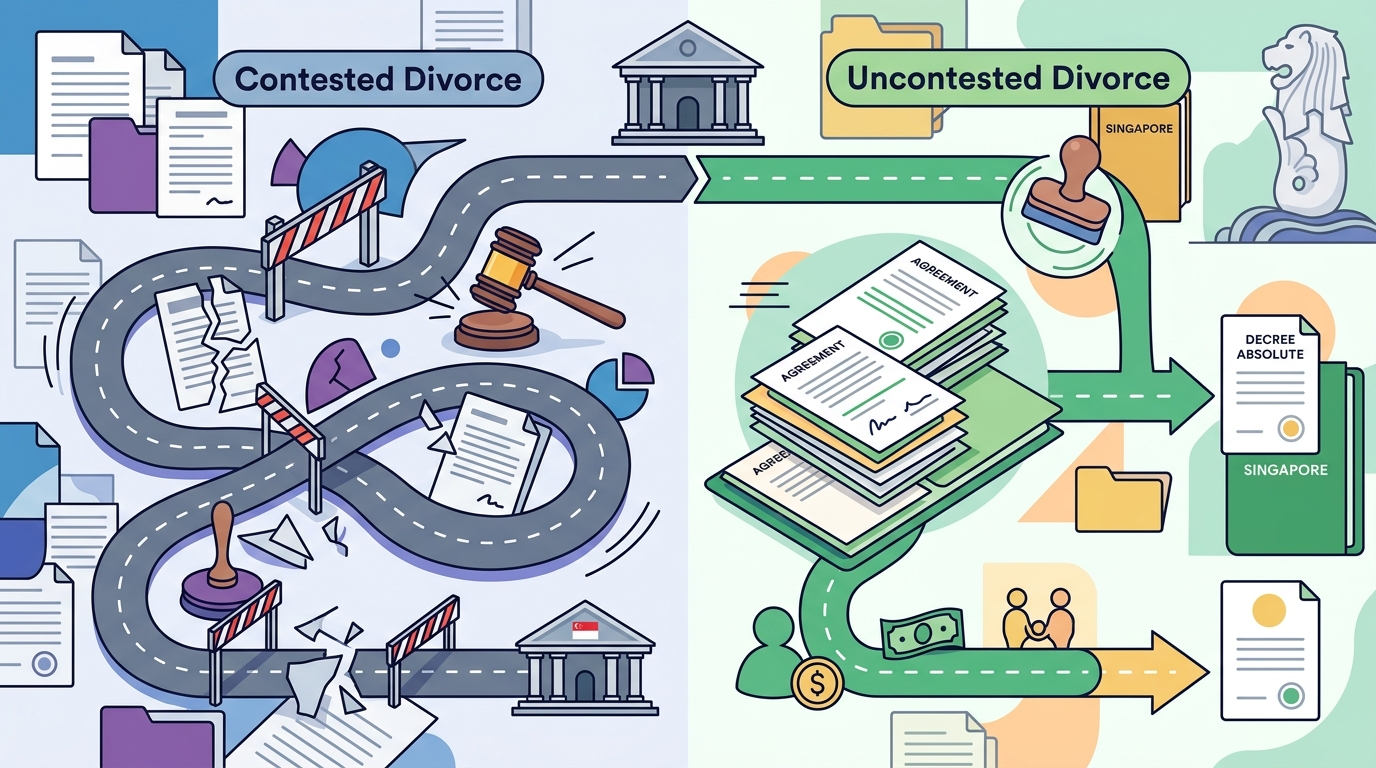
The Contested Divorce Process
A contested divorce arises when one party disagrees with the divorce itself or cannot reach an agreement on ancillary matters. This path is legally intricate, emotionally draining, and significantly more costly. It requires rigorous litigation and court interventions.
Step 1: Dispute and Court Directions
If you cannot agree on the grounds for divorce, the respondent may file a Defence contesting the allegations. Alternatively, if the divorce is agreed upon but ancillary matters are not, the case proceeds to mediation or trial for those specific issues. The court will issue directions for the exchange of affidavits and financial statements. This stage is critical for establishing the factual matrix of the case.
Step 2: Case Conference and Mediation
Singapore courts strongly encourage mediation before proceeding to a full trial. You will attend a Case Conference where a judge will assess the prospects of settlement. If mediation fails, the case is listed for trial. This involves presenting evidence, cross-examining witnesses, and making legal arguments regarding asset division and child custody.
Step 3: Trial and Judgment
The trial can last from a few days to several weeks, depending on the complexity of the assets and disputes. The judge will deliver a judgment on both the divorce and the ancillary matters. This judgment is binding and enforceable. If either party is dissatisfied, they may appeal the decision, further extending the timeline.
Understanding the risks of litigation is vital. Our litigation and dispute resolution team specializes in navigating these complex court procedures.
Key Differences: Timeline and Cost
The distinction between contested and uncontested divorces is not just procedural but also financial and temporal. The table below summarizes the core differences.
| Feature | Uncontested Divorce | Contested Divorce |
|---|---|---|
| Duration | 4 to 6 months (if ancillary matters are settled) | 1 to 3+ years, depending on trial complexity |
| Cost | Lower legal fees and court costs | Significantly higher due to litigation hours and expert witnesses |
| Control | Parties control the outcome through agreement | Judge decides the outcome based on evidence |
| Emotional Impact | Less adversarial and stressful | Highly adversarial and emotionally taxing |
According to legal efficiency reports, uncontested divorces reduce court backlog and allow parties to move forward with their lives more quickly. For those concerned about financial safety during this process, it is essential to understand banking and other scams in Singapore that may target vulnerable individuals.
Protecting Your Assets
During divorce proceedings, financial transparency is key. However, it is also a time when individuals may be targeted by fraudsters. Cross-border money transfers can be particularly risky if not handled through secure, legal channels. Cross-border money transfers in Singapore require careful documentation to ensure compliance with anti-money laundering regulations.
IRB Law LLP provides comprehensive legal support to ensure your assets are protected. We offer will writing and lasting power of attorney services to safeguard your interests before and after the divorce.
Key Takeaways
- Uncontested Divorce: Requires mutual agreement on all matters. It is faster, cheaper, and less stressful.
- Contested Divorce: Involves litigation when agreements cannot be reached. It is time-consuming and costly.
- Irretrievable Breakdown: You must prove one of five facts to file for divorce in Singapore.
- Interim Judgment: This is the first legal step toward divorce but does not end the marriage immediately.
- Final Judgment: Granted after a three-month wait, this legally dissolves the marriage.
- Child Welfare: The court prioritizes the best interests of the child in all custody decisions.
- Legal Counsel: Professional advice is crucial for navigating both contested and uncontested paths.
Frequently Asked Questions
What is the fastest way to get a divorce in Singapore?
The fastest way is through an uncontested divorce where both parties agree on all ancillary matters. If the court process is smooth, it can take approximately four to six months from filing to the Final Judgment.
Can I file for divorce if my spouse does not agree?
Yes, you can file for divorce even if your spouse disagrees. However, if they contest the grounds or ancillary matters, the process becomes a contested divorce, which is longer and more complex.
What happens to our matrimonial home in a divorce?
The matrimonial home is considered a matrimonial asset. Its division depends on the contributions of both parties, whether financial or non-financial. In an uncontested divorce, you can agree on who keeps the home or if it should be sold.
Do I need a lawyer for an uncontested divorce?
While it is possible to file without a lawyer, it is highly recommended to seek legal advice to ensure your rights are protected, especially regarding asset division and child custody.
What is the difference between a Writ of Divorce and a Final Judgment?
A Writ of Divorce initiates the legal process. The Final Judgment is the last step that legally ends the marriage. You cannot remarry until you have obtained the Final Judgment.
How are child custody arrangements determined?
The court determines child custody based on the welfare of the child as the paramount consideration. Factors include the child's wishes, the parents' ability to care for the child, and the existing relationship between the child and each parent.
What is a Consent Order?
A Consent Order is a legal document that records the agreement between both parties on ancillary matters. Once approved by the court, it becomes a binding order that both parties must follow.
Contact IRB Law LLP
Navigating divorce in Singapore requires precision and strategic legal counsel. Whether you are considering an uncontested divorce or facing a complex contested case, IRB Law LLP is here to support you. We provide tailored legal solutions that prioritize your peace of mind and future security.
For a confidential consultation, please contact us today. Our team of experienced family lawyers is ready to guide you through every step of the process.