

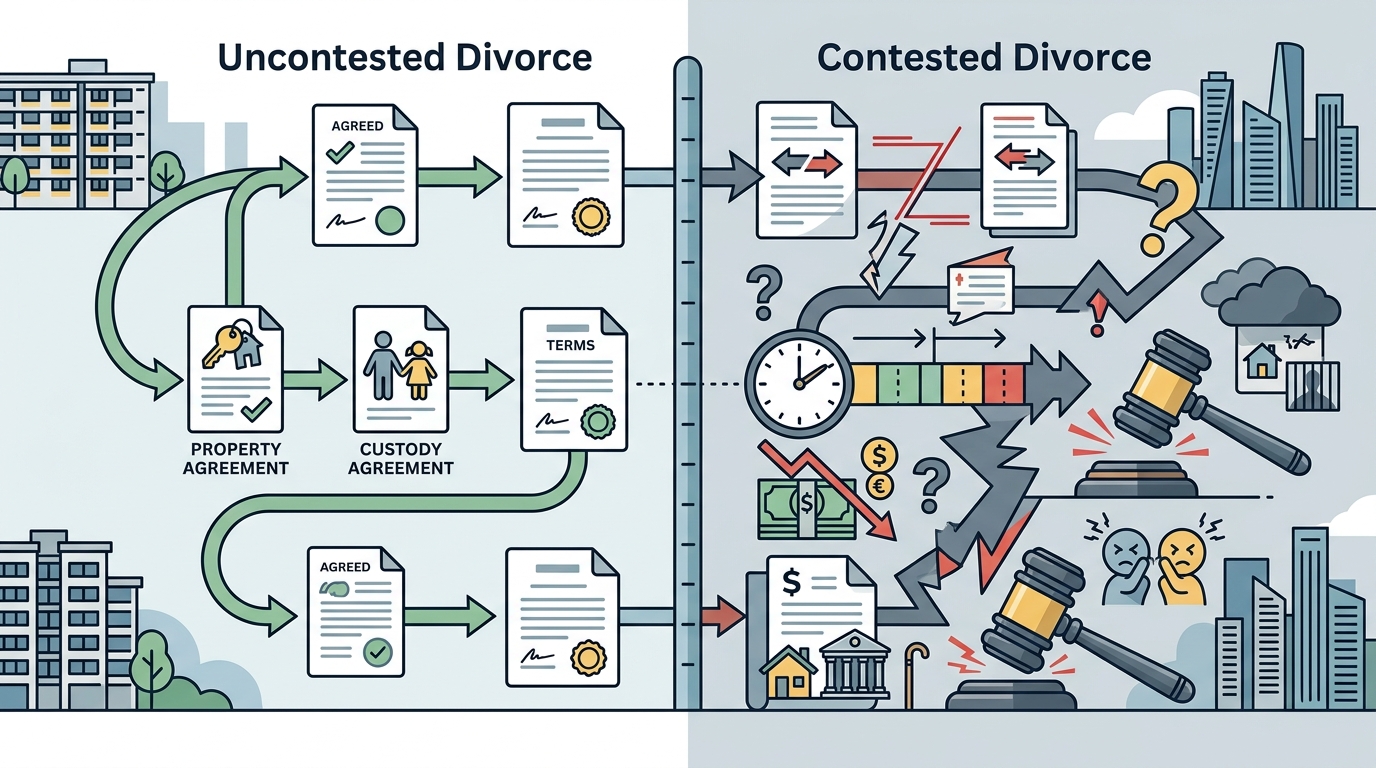
Divorce in Singapore can follow a simplified or a normal path, depending entirely on whether both parties agree on the dissolution and its terms. The distinction between an uncontested and a contested divorce is not merely semantic; it dictates the timeline, financial burden, and emotional toll of the process. According to recent legal insights, the government has introduced stricter penalties for related financial crimes, with maximum penalties of 24 strokes of cane for scammers, highlighting the importance of protecting your assets during this vulnerable period. Understanding the specific legal steps for each route is critical for making informed decisions that protect your future.
The Uncontested Divorce Pathway
An uncontested divorce, often referred to as a simplified divorce, is the most efficient route for couples who have reached a mutual agreement on all major issues. This includes the decision to divorce, the division of matrimonial assets, child custody arrangements, and maintenance payments. The primary advantage of this route is speed and cost-effectiveness.
Step 1: Filing the Writ of Adultery or Divorce
The process begins with the filing of a Writ of Divorce along with a Form 89 (Affidavit in Support of Divorce Petition). In an uncontested scenario, this document outlines the facts of the marriage breakdown and confirms that the respondent (the other spouse) does not oppose the divorce. If the grounds are based on adultery or unreasonable behavior, the respondent's non-opposition is crucial for a smooth progression.
Step 2: The Cooling-Off Period
Singapore law mandates a minimum period of three months between the filing of the Writ and the application for the Interim Judgment. This is a statutory cooling-off period designed to allow for reconciliation efforts. During this time, couples are encouraged to seek counseling. IRB Law provides counselling help resources to assist families in navigating this difficult transition.
Step 3: Applying for the Interim Judgment
After the three-month period has elapsed, the plaintiff can apply for the Interim Judgment (IJ). If the court is satisfied that the marriage has irretrievably broken down and the facts are proven, the IJ is granted. This judgment confirms the divorce but does not yet dissolve the marriage legally.
Step 4: The Certificate of Non-Reconciliation
Following the IJ, there is a mandatory four-month waiting period before the plaintiff can apply for the Certificate of Non-Reconciliation. This certificate confirms that no reconciliation efforts are pending.
Step 5: Final Judgment
Once the Certificate is issued, the plaintiff applies for the Final Judgment. Upon its grant, the marriage is legally dissolved, and both parties are free to remarry. In uncontested cases, this entire process can take approximately four to six months if all paperwork is in order.
The Contested Divorce Process
A contested divorce occurs when one party opposes the divorce or when there are significant disagreements regarding ancillary matters such as asset division, child custody, or maintenance. This path is legally complex, emotionally draining, and significantly more expensive. It requires rigorous litigation and strategic legal representation.
Step 1: Dispute Resolution and Mediation
Before proceeding to full trial, the court often encourages parties to engage in mediation. The goal is to resolve disputes without a trial. However, if mediation fails, the case proceeds to litigation. For those facing employment disputes or wrongful dismissal that may impact financial stability, it is vital to understand your rights. You can find affordable legal advice for employment disputes to ensure your financial position is secure during the divorce proceedings.
Step 2: Filing the Defense and Counter-Petition
The respondent must file a Defense within eight days of receiving the Writ of Divorce. If the respondent wishes to divorce the plaintiff instead, they may file a Counter-Petition. This stage involves detailed pleadings where both sides present their arguments regarding the breakdown of the marriage.
Step 3: Discovery and Interrogatories
This is the most critical phase in a contested divorce. Both parties must disclose all financial documents, including bank statements, property valuations, and business accounts. Interrogatories (written questions) are exchanged to clarify facts. This process is often protracted and can last several months. It is essential to be thorough, as hiding assets can lead to severe legal penalties and adverse court rulings.
Step 4: Case Conference and Trial
The court will hold Case Conferences to manage the progress of the case. If the parties cannot agree, the matter proceeds to a trial. During the trial, witnesses are examined, and evidence is presented. The judge will then make determinations on the divorce itself and the ancillary matters. This process can take anywhere from one to three years or longer, depending on the complexity of the disputes.
Key Differences in Procedure and Cost
Understanding the operational differences between these two paths is essential for strategic planning. The table below summarizes the core distinctions.
| Feature | Uncontested Divorce | Contested Divorce |
|---|---|---|
| Timeline | 4 to 6 months | 1 to 3+ years |
| Cost | Lower (Fixed fees often available) | High (Hourly rates, court fees, expert witnesses) |
| Control | High (Parties agree on terms) | Low (Judge decides outcomes) |
| Emotional Toll | Manageable | Severe |
| Privacy | Relatively private | Public record of detailed financials |
For businesses involved in the divorce, such as founders or shareholders, the division of assets can be complex. A shareholder agreement review is often necessary to determine how business interests are valued and divided.
Grounds for Divorce
Regardless of whether the divorce is contested or uncontested, the plaintiff must prove that the marriage has irretrievably broken down. Singapore law recognizes five facts to establish this:
- Adultery: The respondent has committed adultery, and the plaintiff finds it intolerable to live with them.
- Unreasonable Behavior: The respondent has behaved in such a way that the plaintiff cannot reasonably be expected to live with them.
- Desertion: The respondent has deserted the plaintiff for a continuous period of at least two years.
- Separation for Three Years: The parties have lived apart for at least three years, and the respondent consents to the divorce.
- Separation for Four Years: The parties have lived apart for at least four years. The respondent's consent is not required.
It is important to note that irretrievable breakdown is the sole ground for divorce. The five facts listed above are merely evidence used to prove this breakdown. In contested cases, the burden of proof lies with the plaintiff, and the respondent may challenge the validity of the evidence.
Frequently Asked Questions
Can I file for divorce if my spouse lives abroad?
Yes, you can file for divorce in Singapore if either party has been domiciled in Singapore for at least 15 months immediately before the filing. For cross-border issues, understanding cross-border money transfers is also vital to prevent asset dissipation.
What happens if we cannot agree on child custody?
If custody is disputed, the court will determine the arrangement based on the welfare of the child as the paramount consideration. The court will look at factors such as the child's wishes, the parents' ability to care for the child, and the child's physical and emotional needs.
Is legal aid available for divorce in Singapore?
Legal aid may be available for those who meet specific financial criteria. You can check your eligibility through the Legal Aid Bureau or consult with firms like IRB Law for affordable legal advice tailored to your budget.
How long does the cooling-off period last?
The statutory cooling-off period is three months from the filing of the Writ of Divorce to the application for the Interim Judgment. This period cannot be waived.
What is the difference between an Interim Judgment and a Final Judgment?
An Interim Judgment confirms that the grounds for divorce are met but does not dissolve the marriage. A Final Judgment is granted after the Certificate of Non-Reconciliation and legally ends the marriage, allowing both parties to remarry.
Can I change my mind after filing for divorce?
Yes, you can withdraw your divorce petition at any time before the Final Judgment is granted. However, if the respondent has already filed a defense, you may need their consent to withdraw the case.
What are the risks of hiding assets during a divorce?
Hiding assets is a serious offense. The court can penalize the hiding party by awarding them a smaller share of the matrimonial assets or even ordering them to pay the other party's legal costs. In severe cases, it can lead to contempt of court charges.
Next Steps
Navigating the complexities of divorce requires precise legal strategy and emotional resilience. Whether you are pursuing an uncontested or contested divorce, having experienced legal counsel by your side is essential. IRB Law LLP offers dedicated family law services to guide you through every step of the process.
If you are ready to discuss your specific situation, please contact us today. Our team is available to provide a confidential consultation and help you secure the best possible outcome for your future.