

Financial distress in Singapore is a growing concern, with the Insolvency, Restructuring and Development Trust (IRDT) reporting a significant rise in personal insolvency cases in recent years. According to data from the Ministry of Law, the number of individual bankruptcies has fluctuated but remains a critical legal pathway for those unable to repay debts exceeding S$15,000. Navigating this landscape requires precise legal knowledge, as the wrong choice can lead to long-term financial and professional restrictions. This guide outlines the definitive pathways for handling debt, focusing on the Official Assignee (OA) processes, debt restructuring mechanisms, and the strategic advantages of professional legal intervention.
Understanding Your Options: Debt Restructuring vs Bankruptcy
When debts become unmanageable, individuals in Singapore generally face two primary legal routes: Debt Restructuring or Personal Bankruptcy. The choice between these paths depends heavily on your income level, the nature of your debts, and your willingness to undergo judicial supervision.
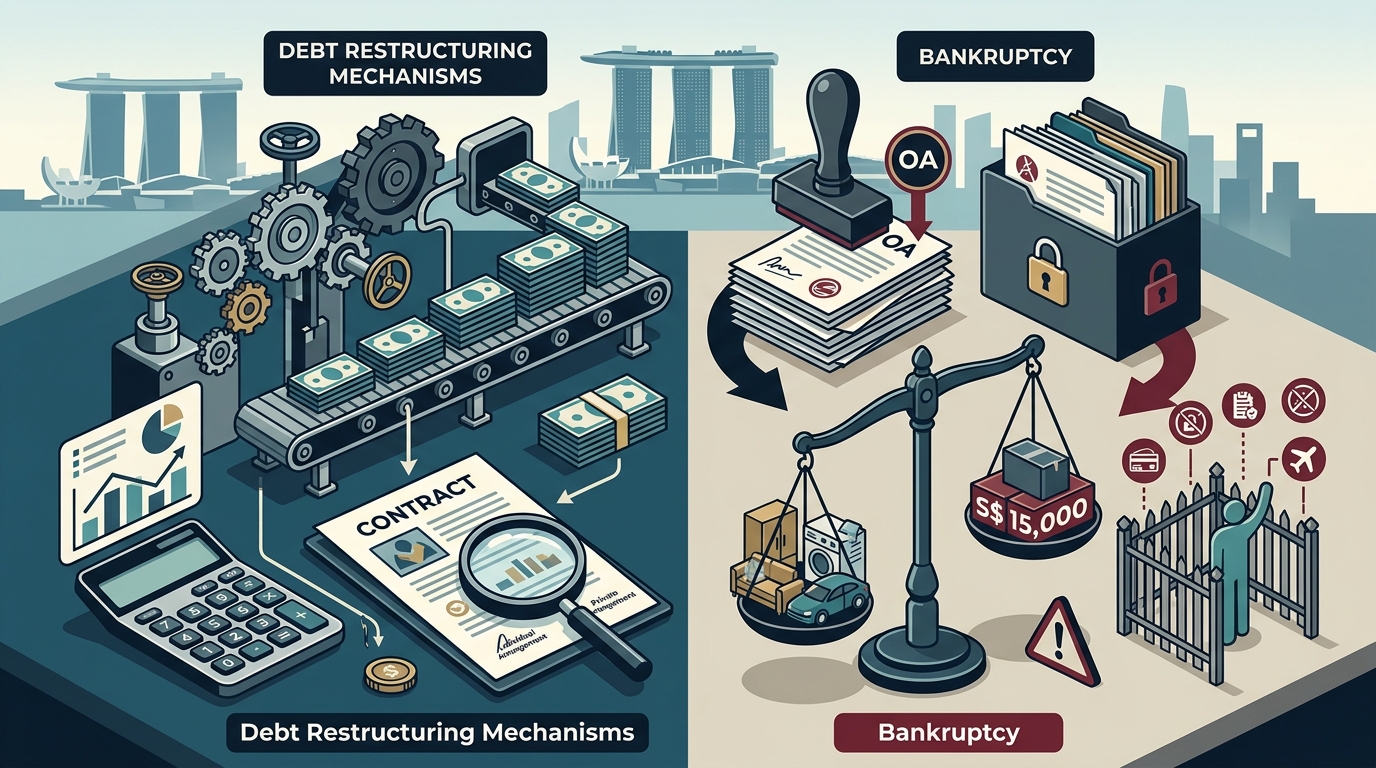
Debt Restructuring is a formal process that allows individuals to negotiate with creditors to pay off debts over a longer period, typically without going bankrupt. It is designed for those who have a steady income but are temporarily cash-flow constrained. On the other hand, Personal Bankruptcy is a legal status declared when an individual is unable to pay their debts as they fall due. It involves the vesting of assets to the Official Assignee for distribution among creditors.
Choosing the correct path is not merely a financial calculation but a legal strategy. At IRB Law LLP, we emphasize that early intervention can preserve your assets and professional standing. Many individuals delay seeking help until a creditor initiates bankruptcy proceedings, which severely limits their options.
The Debt Restructuring Framework (DRF)
The Singapore legal system provides specific mechanisms for debt restructuring, primarily through the Insolvency, Restructuring and Development Trust (IRDT) and the Official Assignee. The most common route for individuals is the Debt Repayment Plan (DRP).
Eligibility for Debt Repayment Plans
To qualify for a DRP, you must meet strict criteria. You must be an individual with a net annual income of less than S$120,000 and total unsecured debts not exceeding S$450,000. If your debts exceed this limit, you may need to consider other forms of restructuring or bankruptcy.
The DRP allows you to repay your debts over a period of up to five years. During this time, interest and penalties are typically frozen, providing immediate relief from the compounding nature of high-interest credit card debts and personal loans.
The Role of Legal Counsel
While you can apply for a DRP directly through the Official Assignee, the process is complex. It requires detailed financial disclosure and negotiation with multiple creditors. Legal counsel ensures that your proposal is realistic and compliant with the Insolvency, Restructuring and Discharge of Bankrupts Act. Without proper legal framing, creditors may reject your plan, forcing you into bankruptcy.
For those with cross-border elements or complex corporate ties, cross-border financial issues can complicate restructuring efforts. IRB Law LLP provides specialized advice for expatriates and individuals with international financial obligations.
The Personal Bankruptcy Process
If debt restructuring is not viable, personal bankruptcy may be the necessary step. This is a serious legal declaration that impacts your financial life for several years.
How Bankruptcy is Initiated
Bankruptcy can be initiated in two ways:
- Creditor's Petition: A creditor owing you at least S$15,000 files a petition in court because you have failed to comply with a bankruptcy notice.
- Debtor's Petition: You voluntarily file for bankruptcy if you are unable to pay your debts. This is often a strategic move to stop legal actions and interest accumulation.
Once the bankruptcy order is made, your assets vest in the Official Assignee. This includes property, vehicles, and other valuables, though some essential items may be exempt.
Discharge from Bankruptcy
The duration of bankruptcy depends on your conduct and financial situation. Typically, you may be discharged after three to five years if you cooperate fully with the Official Assignee and contribute to your estate. However, if you have been involved in banking scams or fraudulent activities, the process can be significantly extended or even indefinite.
IRB Law LLP assists clients in preparing for the discharge process, ensuring all documentation is in order to minimize the duration of financial restrictions.
Comparing Outcomes and Consequences
Understanding the long-term implications of each path is crucial. The following table summarizes the key differences between Debt Restructuring and Personal Bankruptcy.
| Feature | Debt Repayment Plan (DRP) | Personal Bankruptcy |
|---|---|---|
| Income Threshold | Net annual income < S$120,000 | No strict income limit, but affects disposable income |
| Debt Limit | Unsecured debts ≤ S$450,000 | No upper limit on debt amount |
| Asset Retention | You retain all assets | Assets vest in the Official Assignee |
| Duration | Up to 5 years | 3 to 5 years (minimum) |
| Credit Record | Noted in credit bureau, but less severe | Severe negative impact for 5+ years |
| Professional Restrictions | Minimal | Cannot be a company director or hold certain licenses |
As noted by financial experts, the stigma of bankruptcy can affect future employment opportunities, particularly in the financial sector. Therefore, exploring debt restructuring options first is often the preferred strategic move for professionals.
Key Takeaways
- Threshold for Bankruptcy: A creditor can file for your bankruptcy if the debt exceeds S$15,000 and you fail to pay within the statutory period.
- DRP Eligibility: You must have a net annual income below S$120,000 and unsecured debts not exceeding S$450,000 to qualify for a Debt Repayment Plan.
- Asset Protection: Debt restructuring allows you to keep your assets, whereas bankruptcy results in the vesting of assets to the Official Assignee.
- Legal Counsel Importance: Navigating the Insolvency, Restructuring and Discharge of Bankrupts Act requires precise legal documentation to avoid rejection or extended bankruptcy periods.
- Scam Awareness: Victims of banking scams should seek immediate legal advice to freeze accounts and prevent further loss before addressing debt.
- Discharge Timeline: The minimum period for discharge from bankruptcy is typically three years, provided you comply with all obligations.
- Professional Impact: Bankrupt individuals are restricted from acting as company directors, which can have significant career implications.
Frequently Asked Questions
Can I file for bankruptcy if I have assets?
Yes, you can file for bankruptcy even if you have assets. However, these assets will vest in the Official Assignee and may be sold to pay off your creditors. Legal advice can help identify exempt assets.
What is the difference between a Debt Repayment Plan and Individual Voluntary Arrangement (IVA)?
A Debt Repayment Plan (DRP) is administered by the Official Assignee for individuals with lower incomes and debts under S$450,000. An IVA is a private agreement with creditors, often used for higher debt amounts, and requires a higher income threshold.
How long does bankruptcy last in Singapore?
The standard period is three to five years. However, this can be extended if you fail to cooperate with the Official Assignee or if there are complications such as fraudulent transfers of assets.
Can I still work while bankrupt?
Yes, you can continue to work. However, you cannot act as a company director or hold certain professional licenses without court permission. You must also disclose your bankruptcy status to your employer if required by your contract.
What happens to my HDB flat if I go bankrupt?
If you own an HDB flat, it is considered an asset and may vest in the Official Assignee. However, the OA may allow you to retain it if you can continue paying the mortgage and there is little equity to realize.
Is debt restructuring available for secured debts?
Debt restructuring primarily focuses on unsecured debts. Secured debts, such as car loans or mortgages, are handled separately. However, legal counsel can help negotiate with secured creditors to prevent repossession.
How can IRB Law LLP help with debt issues?
IRB Law LLP provides comprehensive legal services including debt recovery analysis, restructuring negotiations, and bankruptcy representation. We help clients navigate the complexities of the Insolvency, Restructuring and Discharge of Bankrupts Act to achieve the best possible outcome.
Contact IRB Law LLP
Debt restructuring and bankruptcy are complex legal matters that require expert guidance. Do not wait until a creditor takes action. Contact IRB Law LLP today for a confidential consultation. Our team of experienced lawyers specializes in personal insolvency and can help you protect your future.
Visit our home page to learn more about our legal services or call us at +65 6298 2537 to schedule an appointment.