

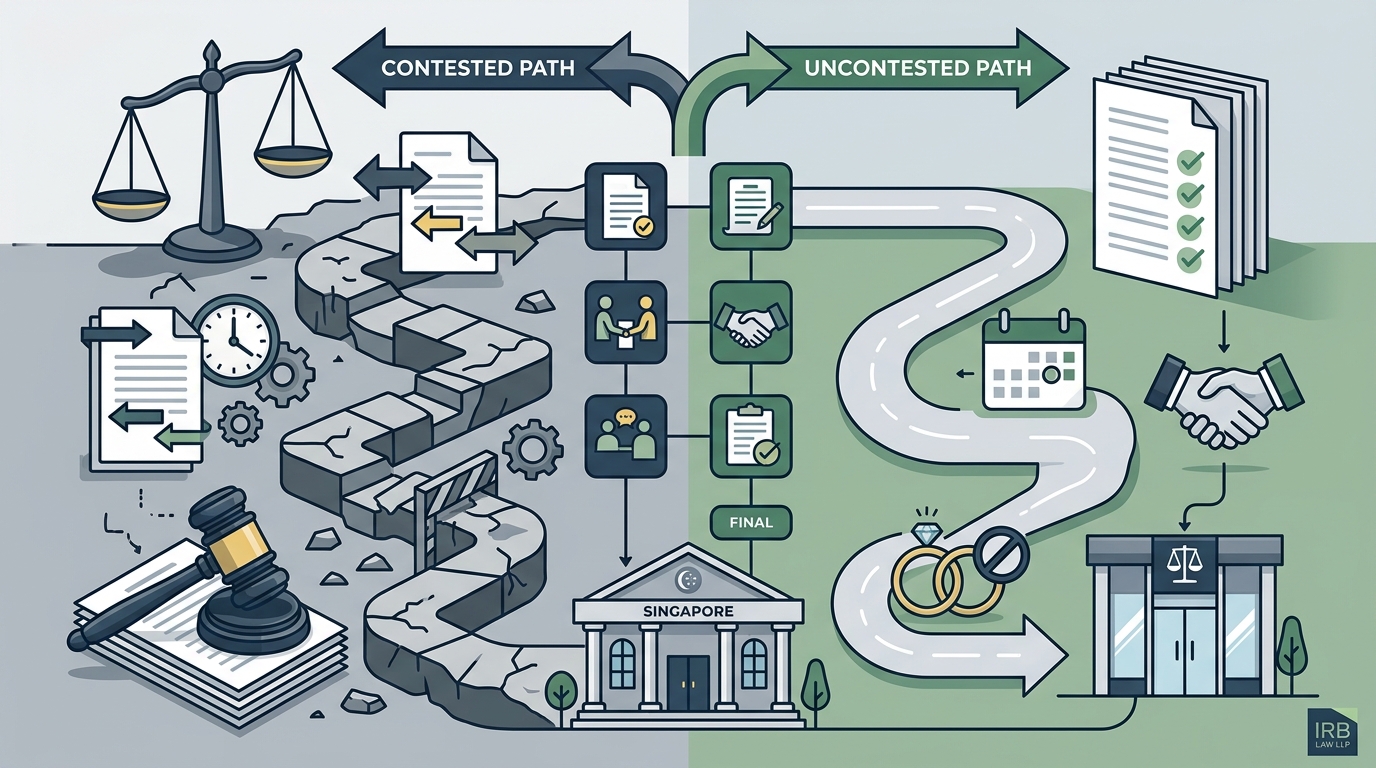
Divorce in Singapore can follow a simplified or a normal path, depending entirely on whether both parties agree on the dissolution and its terms. Understanding the distinction between contested and uncontested divorce is critical for minimizing legal fees and emotional strain. Recent insights from legal professionals highlight that the procedural route you choose dictates the timeline, which can range from a few months to several years. This guide breaks down the exact legal steps for both scenarios under Singapore law.
Uncontested Divorce: The Simplified Route
An uncontested divorce, often referred to as an undefended divorce, occurs when both spouses agree to the divorce itself and have reached a mutual understanding on ancillary matters such as child custody, maintenance, and asset division. This is the most common and efficient path for couples seeking to end their marriage amicably.
Step 1: Filing the Writ of Adultery or Divorce
The process begins with the filing of a Writ of Divorce along with a Form 85 (Affidavit in Support of Divorce). In an uncontested scenario, the plaintiff files these documents with the Family Justice Courts. The affidavit details the marriage breakdown, specifically citing one of the five irretrievable breakdown facts, such as adultery, unreasonable behavior, or separation.
Step 2: Service of Process and Acknowledgment
Once filed, the documents must be served to the defendant. In an uncontested case, the defendant typically files an Acknowledgment of Service indicating that they do not intend to defend the divorce petition. This is a crucial procedural step that signals the court that the divorce is not being challenged.
Step 3: Interim Judgment
After the service is complete, the plaintiff can apply for an Interim Judgment (IJ). This judgment confirms that the court is satisfied with the grounds for divorce. However, the marriage is not yet legally dissolved at this stage. The IJ is a prerequisite before the Final Judgment can be granted.
Step 4: Final Judgment of Divorce
There is a mandatory waiting period of 12 weeks from the date of the Interim Judgment before the plaintiff can apply for the Final Judgment of Divorce (FJD). Once granted, the FJD legally dissolves the marriage, allowing both parties to remarry. For uncontested cases, this entire process can often be completed in 4 to 6 months if all paperwork is in order.
For more details on the specific legal steps for contested versus uncontested divorce, IRB Law provides comprehensive guidance on navigating these procedural requirements.
Contested Divorce: The Complex Path
A contested divorce arises when one spouse disagrees with the divorce, disputes the grounds cited, or cannot reach an agreement on ancillary matters such as child custody or asset division. This path is significantly more litigious, expensive, and time-consuming.
Step 1: Filing the Writ and Statement of Claim
Similar to the uncontested route, the process starts with filing a Writ of Divorce. However, in a contested case, the plaintiff must also file a Statement of Claim detailing the specific facts supporting the irretrievable breakdown. If the defendant wishes to defend the divorce, they must file a Defence within 14 days of receiving the Writ.
Step 2: Case Management Conference (CMC)
Once the Defence is filed, the case is listed for a Case Management Conference. During this hearing, the judge assesses the issues in dispute and sets a timeline for the exchange of affidavits and evidence. The court encourages parties to resolve disputes, but if they cannot, the case proceeds to trial.
Step 3: Exchange of Affidavits and Evidence
Both parties must file affidavits addressing the contested issues. In cases involving children, the court may require a Custody Investigation Report from the Official Assignee. If financial assets are disputed, detailed financial statements and disclosure of assets are mandatory. This stage is often the most protracted, involving extensive legal correspondence and negotiation.
Step 4: Trial and Judgment
If the parties cannot reach a settlement, the case proceeds to a full trial. Both sides present their evidence and arguments before a judge. The judge will then make determinations on the divorce grounds and all ancillary matters. The timeline for a contested divorce can easily exceed 12 to 24 months, depending on the complexity of the disputes and court availability.
Understanding the legal steps for contested versus uncontested divorce is vital for managing expectations. IRB Law offers expert advice on navigating complex legal landscapes, including corporate and personal disputes.
Key Differences in Process and Cost
The choice between a contested and uncontested divorce has profound implications for both time and financial resources. The table below summarizes the critical distinctions.
| Feature | Uncontested Divorce | Contested Divorce |
|---|---|---|
| Agreement Status | Both parties agree on divorce and terms. | Disagreement on divorce or ancillary matters. |
| Timeline | 4 to 6 months (average). | 12 to 24+ months (variable). |
| Legal Costs | Lower (fixed or capped fees common). | High (hourly rates, trial costs). |
| Court Involvement | Minimal (mostly procedural hearings). | Extensive (CMCs, trials, multiple hearings). |
| Emotional Toll | Lower (amicable resolution). | High (adversarial process). |
According to data from the Ministry of Finance and various legal surveys, the cost disparity is significant. Uncontested divorces often cost a fraction of contested ones because they avoid the extensive discovery and trial phases. For those facing financial disputes, IRB Law provides insights on financial investigations and asset tracing.
Legal Grounds for Divorce
Regardless of whether the divorce is contested or uncontested, Singapore law requires proof of irretrievable breakdown of marriage. This is established by proving one of five facts:
- Adultery: The respondent has committed adultery, and the petitioner finds it intolerable to live with them.
- Unreasonable Behavior: The respondent has behaved in such a way that the petitioner cannot reasonably be expected to live with them.
- Desertion: The respondent has deserted the petitioner for a continuous period of at least two years.
- Separation for Two Years: The parties have lived apart for a continuous period of at least two years and both consent to the divorce.
- Separation for Four Years: The parties have lived apart for a continuous period of at least four years (consent is not required).
These grounds are strictly interpreted by the courts. The Supreme Court of Singapore provides official resources on family law procedures and statutory requirements.
Frequently Asked Questions
What is the fastest way to get a divorce in Singapore?
The fastest way is through an uncontested divorce where both parties agree on all terms. If the separation period is two years with consent, or based on adultery/unreasonable behavior, the process can be completed in approximately 4 to 6 months.
Can I divorce my spouse if they do not agree?
Yes, but it becomes a contested divorce. You must prove one of the five irretrievable breakdown facts. The process will be longer and more expensive as it involves litigation and potentially a trial.
What happens if we cannot agree on child custody?
If custody is disputed, the court will determine the arrangement based on the welfare of the child as the paramount consideration. The court may order a custody investigation and mediation before proceeding to trial.
Do we need a lawyer for an uncontested divorce?
While not legally mandatory, it is highly recommended to have a lawyer review your agreement on ancillary matters to ensure fairness and enforceability. IRB Law's family law team specializes in drafting robust separation agreements.
How long does the 12-week waiting period last?
The 12-week waiting period starts from the date the Interim Judgment is granted. During this time, parties can address any issues regarding the divorce or ancillary matters before the Final Judgment is issued.
What is the difference between a Writ of Divorce and a Final Judgment?
A Writ of Divorce initiates the legal process, while the Final Judgment legally dissolves the marriage. The marriage is not ended until the Final Judgment is granted by the court.
Can we modify our divorce agreement after the Final Judgment?
Generally, no. Ancillary matters are usually finalized before the Final Judgment. However, in rare cases, the court may allow variations if there is a significant change in circumstances, such as a change in the child's needs.
Secure Your Legal Future Today
Navigating the legal steps for contested versus uncontested divorce requires precision and expertise. Whether you are seeking an amicable resolution or facing complex disputes, professional guidance is essential. Contact IRB Law LLP today to schedule a consultation with our experienced family lawyers. We provide trusted, transparent legal support tailored to your unique situation.