

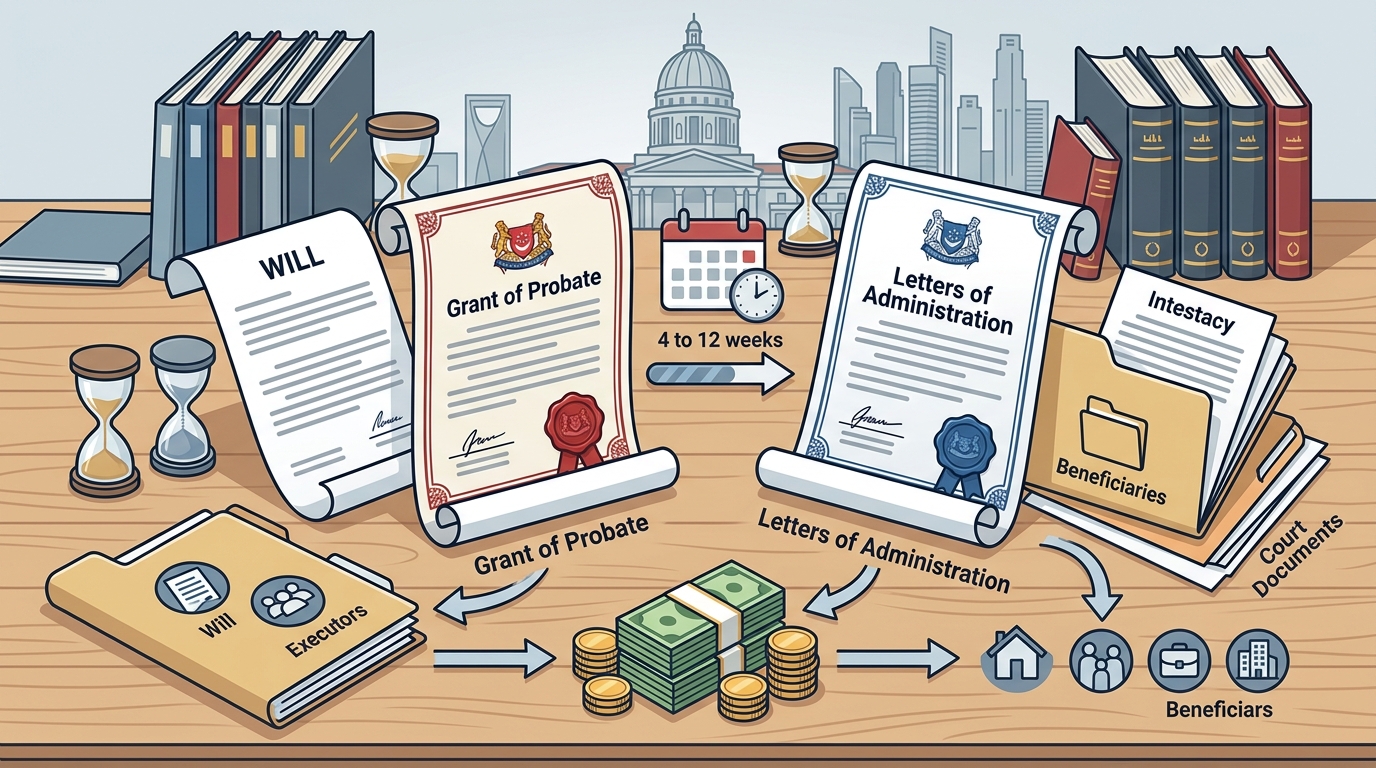
Securing the legal authority to manage a deceased person's estate is a critical first step in the Singapore probate process. According to recent industry data, the average time to obtain a Grant of Probate or Letters of Administration in Singapore can range from 4 to 12 weeks, depending on the complexity of the estate and court backlogs. This delay often causes significant financial strain for beneficiaries who need immediate access to funds for funeral expenses or debt settlement. Understanding the precise legal requirements and procedural differences between these two grants is essential for navigating the Singapore legal system efficiently and avoiding costly delays. (Cross Border Money Transfers)
What Is a Grant of Probate?
A Grant of Probate is a legal document issued by the Singapore High Court that confirms the validity of a will and appoints the executors named within that will. Grant of Probate is the formal court order that empowers executors to administer the estate. Without this grant, financial institutions, property registries, and other entities will typically refuse to release assets or transfer ownership, regardless of what the will states.
This process is only applicable when the deceased left a valid and legally binding will. The will must clearly identify the executors who are responsible for carrying out the deceased's wishes. If the will does not name an executor, or if the named executors are unwilling or unable to act, the court may appoint an administrator instead, which shifts the process toward Letters of Administration.
For families dealing with the loss of a loved one, the emotional burden is often compounded by bureaucratic complexity. IRB Law LLP provides specialized support to ensure that the probate application is filed correctly and promptly. You can learn more about our Probate & Letters of Administration Services to understand how we streamline this critical phase.
When Do You Need Letters of Administration?
Letters of Administration are required when a person dies intestate, meaning they did not leave a valid will, or when the will fails to appoint any executors. In these scenarios, the court must appoint an administrator to manage the estate according to the Intestate Succession Act or the Distribution Act, depending on the deceased's religion and marital status.
Letters of Administration is the legal authority granted to an administrator to handle an intestate estate. The priority of who can apply for this grant is strictly regulated by law. Typically, the surviving spouse or children have the highest priority. If they are unavailable, the court may look to parents, siblings, or other relatives.
It is crucial to distinguish this from a Grant of Probate. While Probate validates a will, Letters of Administration essentially creates a legal framework for distribution where no will exists. This distinction affects who gets to manage the estate and how the assets are ultimately divided. For more insights on estate planning to avoid intestacy, review our Will Writing services.
Eligibility and Priority of Applicants
The Singapore courts maintain strict guidelines regarding who is eligible to apply for these grants. The priority list is designed to ensure that those closest to the deceased have the first right to manage the estate.
For Grant of Probate
Any executor named in the will can apply. If there are multiple executors, they can apply jointly or individually. If an executor declines to act, they must sign a document renouncing their right to probate, allowing another named executor or a beneficiary to apply instead.
For Letters of Administration
The priority order for applicants is generally as follows:
- The surviving spouse or civil partner.
- The children of the deceased (if a minor, through a guardian).
- The parents of the deceased.
- The brothers and sisters of the deceased.
- Other relatives as determined by the court.
If multiple people have equal priority, they may apply jointly. If they cannot agree, the court will decide who is best suited to administer the estate. This is where professional legal guidance becomes invaluable. Our team at IRB Law LLP can assess your specific situation and advise on the most efficient path forward.
The Step-by-Step Application Process
Applying for either grant involves several rigorous steps. The process is largely conducted through the Singapore Probate and Trusts Office (PTO). Below is the general workflow for both types of applications.
1. Gather Required Documents
You must collect the original will (if applicable), the death certificate, and a detailed inventory of the deceased's assets and liabilities. This includes bank accounts, properties, investments, and personal belongings. For properties, you will need the title deeds. For bank accounts, you will need statements showing the balance at the time of death.
2. File the Application
The application is filed electronically via the Singapore Courts' eLitigation system. You must submit a Grant Application Form, an Affidavit of Assets and Liabilities, and the proposed Grant. If the estate exceeds a certain value, or if there are complexities, you may need to engage a lawyer to file the documents.
3. Pay the Court Fees
Court fees are calculated based on the gross value of the estate. The fee structure is tiered, meaning higher-value estates incur higher fees. It is important to budget for these costs early in the process. For a detailed breakdown of costs, you can consult our Insights section or contact us directly.
4. Court Review and Issuance
The court will review the documents for completeness and accuracy. If everything is in order, the Grant will be issued. If there are errors or missing documents, the court will return the application for correction, which can delay the process significantly. This is why precision is paramount.
5. Collect the Grant
Once issued, the executor or administrator must collect the original Grant. This document is then presented to financial institutions and other asset holders to release the funds or transfer ownership.
For complex estates involving cross-border assets or disputed claims, professional assistance is highly recommended. IRB Law LLP offers comprehensive Probate & Letters of Administration Services to handle these complexities.
Probate vs. Letters of Administration: Key Differences
Understanding the nuances between these two grants is vital for effective estate administration. The following table summarizes the primary distinctions.
| Feature | Grant of Probate | Letters of Administration |
|---|---|---|
| Applicability | When a valid will exists. | When the deceased died intestate (no will). |
| Applicant | The executor(s) named in the will. | A beneficiary or relative with priority rights. |
| Legal Basis | The deceased's will. | The Intestate Succession Act or Distribution Act. |
| Asset Distribution | According to the will's instructions. | According to statutory legal formulas. |
| Complexity | Generally straightforward if the will is clear. | Can be complex due to priority disputes. |
Both processes require strict adherence to legal protocols. Errors in the application can lead to rejection or delays. For expert guidance on which grant applies to your situation, reach out to our Contact Us team.
Key Takeaways
- Grant of Probate is required only when a valid will exists and names executors.
- Letters of Administration are necessary for intestate estates or when no executor is available.
- Priority of Applicants is strictly defined by law, with spouses and children typically having the highest priority.
- Court Fees are calculated based on the gross value of the estate and can be significant.
- Processing Time typically ranges from 4 to 12 weeks, depending on court workload and estate complexity.
- Legal Assistance is highly recommended for estates with cross-border assets or family disputes.
- IRB Law LLP provides specialized support for both Probate and Letters of Administration applications.
Frequently Asked Questions
How long does it take to get a Grant of Probate in Singapore?
The average time is between 4 to 12 weeks. Delays can occur if the court requires additional documents or if there are disputes among beneficiaries.
Can I apply for Letters of Administration if I am not a family member?
Generally, no. The court prioritizes family members. However, in rare cases, a creditor or other interested party may apply if no family member is willing to act.
What happens if the will does not name an executor?
If no executor is named, or if the named executor declines, the court will appoint an administrator, and the process will shift to Letters of Administration.
Do I need a lawyer to apply for Probate?
While it is possible to apply without a lawyer, it is highly recommended for estates with significant assets or complexities. Lawyers ensure compliance with court rules and prevent costly errors.
What is the difference between a Will and a Probate?
A Will is the legal document outlining the deceased's wishes. Probate is the court order that validates the Will and empowers the executor to act.
Can I challenge a Grant of Probate?
Yes, beneficiaries or interested parties can challenge the validity of the Will or the grant itself on grounds such as lack of testamentary capacity or undue influence.
What documents are needed for the application?
You will need the original Will, the death certificate, an affidavit of assets and liabilities, and proof of identity for the applicant.
Contact IRB Law LLP
Navigating the probate process can be overwhelming. IRB Law LLP is dedicated to providing compassionate and expert legal support during this difficult time. Our team specializes in Probate & Letters of Administration Services and can guide you through every step of the application.
Do not wait until the last minute. Contact us today to schedule a consultation. You can reach us via our Contact Us page, by calling +65 6298 2537, or by emailing hello@irblaw.com.sg. Let us help you secure the estate with confidence and clarity.