

Contested vs Uncontested Divorce in Singapore: Legal Steps Explained
Filing for divorce in Singapore can follow very different paths depending on whether you and your spouse agree on the terms. An uncontested divorce is a streamlined process where both parties consent to the divorce and all ancillary matters. A contested divorce, on the other hand, occurs when spouses disagree on one or more issues, requiring court intervention. Understanding the legal steps for each route helps you plan your timeline, budget, and emotional resources. Below, we break down both processes so you can make an informed decision about how to proceed.
Eligibility Requirements for Divorce in Singapore
Before either a contested or uncontested divorce can proceed, certain threshold requirements must be met. These are set out in the Women's Charter and apply to all civil divorces heard at the Family Justice Courts.
Residency and Duration of Marriage
At least one spouse must be domiciled in Singapore or have been habitually resident in the country for at least three continuous years before filing. Additionally, the marriage must generally be at least three years old, unless the applicant can demonstrate exceptional hardship or depravity on the part of the other spouse.
Irretrievable Breakdown
The sole legal ground for divorce in Singapore is the irretrievable breakdown of the marriage. This must be proven by establishing one of several facts, including adultery, unreasonable behaviour, desertion, separation, or, since July 2024, divorce by mutual agreement.
Grounds for Divorce Under the Women's Charter
Irretrievable breakdown is a legal standard that requires proof through at least one of the following facts:
- Adultery — the respondent committed adultery and the petitioner finds it intolerable to live with them.
- Unreasonable behaviour — the respondent behaved in a way that makes continued cohabitation unreasonable. Learn more about divorce due to unreasonable behaviour in Singapore.
- Desertion — the respondent deserted the petitioner for a continuous period of at least two years.
- Separation (3 or 4 years) — the spouses have lived apart for three years (with consent) or four years (without consent). Read our guide on marital separation in Singapore.
- Mutual agreement — both spouses agree to divorce without assigning fault, under the Divorce by Mutual Agreement provision effective from 1 July 2024.
Legal Steps for an Uncontested Divorce
An uncontested divorce is the simplest and most cost-effective route. It applies when both spouses agree on the fact of divorce and all ancillary matters, including child custody, maintenance, and division of assets.
Step 1: Mandatory Programmes
If the couple has at least one child below 21, they must attend mandatory counselling and mediation at the Child Focused Resolution Centre. For couples with children under 14 on the standard track, the Mandatory Parenting Programme must also be completed. Read more about divorce mediation in Singapore.
Step 2: Filing the Originating Application
The plaintiff files an Originating Application for Divorce along with supporting documents, including an Affidavit of Evidence-in-Chief, the marriage certificate, and bankruptcy searches on both parties. The defendant files a Consent to the Originating Application.
Step 3: Interim Judgment and Final Judgment
Once the court reviews the documents and is satisfied the marriage has irretrievably broken down, it grants an Interim Judgment. The hearing is typically scheduled within four to six weeks and is held in chambers, meaning parties and lawyers need not attend. After a mandatory three-month waiting period, either party can extract the Final Judgment to formally end the marriage.
Legal Steps for a Contested Divorce
A contested divorce is the process that applies when spouses disagree on the divorce itself, the grounds, or any ancillary matter. It involves additional procedural steps and significantly more time and cost.
Step 1: Filing and Service
The plaintiff files an Originating Application for Divorce (Form No. 2A) along with supporting affidavits. The divorce papers are then served on the respondent, who has 14 days to file a Notice to Contest and 28 days to file a Reply disputing the grounds for divorce.
Step 2: Case Conferences and Mediation
After the defence is filed, the plaintiff or respondent files a Request for a Hearing Date (Form No. 6). The court then schedules case conferences to manage the proceedings and may direct parties to attend mediation or counselling. Singapore's Family Justice Courts actively encourage settlement, and around 90% of contested cases resolve before trial.
Step 3: Trial, Interim Judgment, and Final Judgment
If mediation fails, the case proceeds to trial where both parties present evidence and witnesses. A contested trial can run for days depending on complexity. Once the court grants the Interim Judgment, the same three-month waiting period applies before the Final Judgment can be extracted.
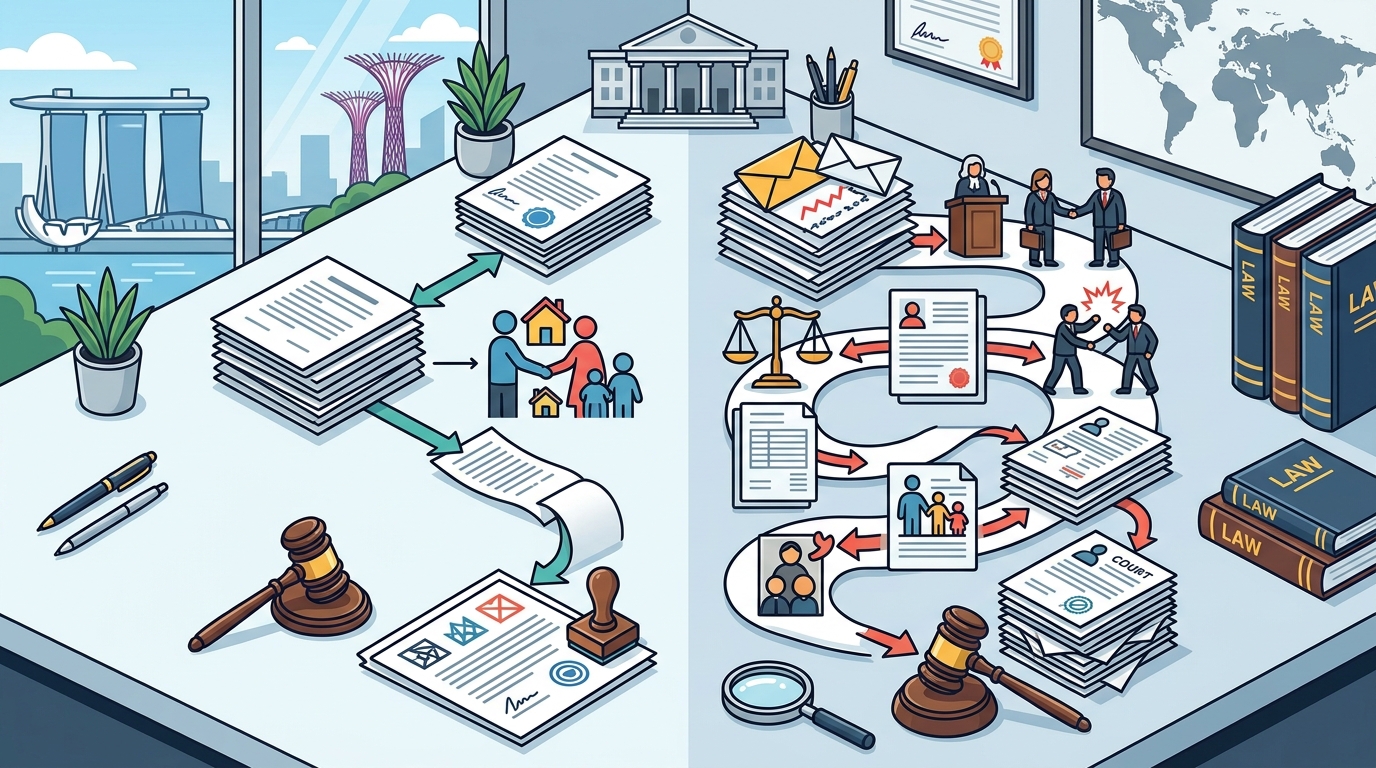
Side-by-Side Comparison: Contested vs Uncontested Divorce
| Factor | Uncontested Divorce | Contested Divorce |
|---|---|---|
| Agreement on issues | Full agreement on all matters | Disagreement on one or more issues |
| Typical timeline | 4 to 6 months | 12 months or longer |
| Estimated legal fees | SGD $1,600 to $3,500 | SGD $10,000 to $35,000+ |
| Court hearing | In chambers; attendance usually not required | Open court trial; attendance required |
| Mediation | Optional (unless children involved) | Often court-directed or mandatory |
| Emotional toll | Generally lower | Generally higher due to adversarial process |
Ancillary Matters: Custody, Maintenance, and Assets
Regardless of whether your divorce is contested or uncontested, the court must address ancillary matters once the marriage is dissolved. These include three key areas.
Child custody is the legal right to make major decisions about a child's upbringing, including education and religion. Singapore courts generally favour joint custody arrangements. For detailed guidance, consult IRB Law's child custody lawyers.
Spousal and child maintenance is a form of financial support ordered by the court under Section 113 of the Women's Charter. The court considers each party's income, earning capacity, and financial needs. Learn about your options on the maintenance services page.
Division of matrimonial assets is the process by which the court distributes property, CPF savings, and other jointly held assets. The court uses both direct financial and indirect non-financial contributions to arrive at a just and equitable split. More details are available in our guide to division of matrimonial assets.
Key Takeaways
- The sole ground for divorce in Singapore is the irretrievable breakdown of the marriage, proven through one of several prescribed facts or by mutual agreement.
- An uncontested divorce typically takes 4 to 6 months and costs between SGD $1,600 and $3,500 in legal fees.
- A contested divorce can take 12 months or longer and cost SGD $10,000 to $35,000 or more.
- Both paths include two main stages: dissolution of the marriage and resolution of ancillary matters.
- Since 1 July 2024, couples can divorce by mutual agreement without citing fault-based reasons.
- About 90% of contested divorces settle before trial, often through court-directed mediation.
- Engaging an experienced divorce lawyer early can help convert a contested case to an uncontested one, saving time and costs.
Frequently Asked Questions
What is the difference between a contested and uncontested divorce in Singapore?
An uncontested divorce occurs when both parties agree on all terms, including grounds for divorce and ancillary matters. A contested divorce happens when they disagree on one or more issues, requiring the court to decide.
How long does an uncontested divorce take in Singapore?
An uncontested divorce typically takes around 4 to 6 months from filing to the extraction of the Final Judgment. This includes a mandatory 3-month waiting period after the Interim Judgment.
How much does a contested divorce cost in Singapore?
Contested divorces generally range from SGD $10,000 to $35,000 or more, depending on the complexity of the issues and whether the case proceeds to trial.
Can a contested divorce become uncontested?
Yes. If both parties reach agreement on all outstanding issues during proceedings, the divorce can convert from contested to uncontested. This can save considerable time and legal costs.
What are the grounds for divorce in Singapore?
The sole ground is irretrievable breakdown of the marriage, proven by adultery, unreasonable behaviour, desertion, separation (3 or 4 years), or mutual agreement under the 2024 amendment to the Women's Charter.
Do I need a lawyer for an uncontested divorce?
While it is technically possible to file without a lawyer, documentation errors frequently lead to rejection or delays. Most individuals engage a divorce lawyer to ensure compliance with court requirements.
What happens to the children in a divorce?
The court decides on custody, care and control, and access arrangements based on the welfare principle, which prioritises the best interests of the child. Singapore courts generally order joint custody with one parent having primary care and control.
What is the Divorce by Mutual Agreement (DMA) provision?
Effective 1 July 2024, the DMA provision allows couples to apply for divorce by mutual agreement without citing fault-based reasons such as adultery or desertion. It aims to reduce conflict and emotional distress during the divorce process.
Speak to a Divorce Lawyer Today
Whether you are considering an uncontested divorce or facing a contested one, having the right legal guidance makes all the difference. At IRB Law, our experienced divorce lawyers provide transparent advice, affordable fees, and compassionate support at every stage of your divorce. Contact us today at +65 6298 2537 or email hello@irblaw.com.sg to schedule your consultation.